
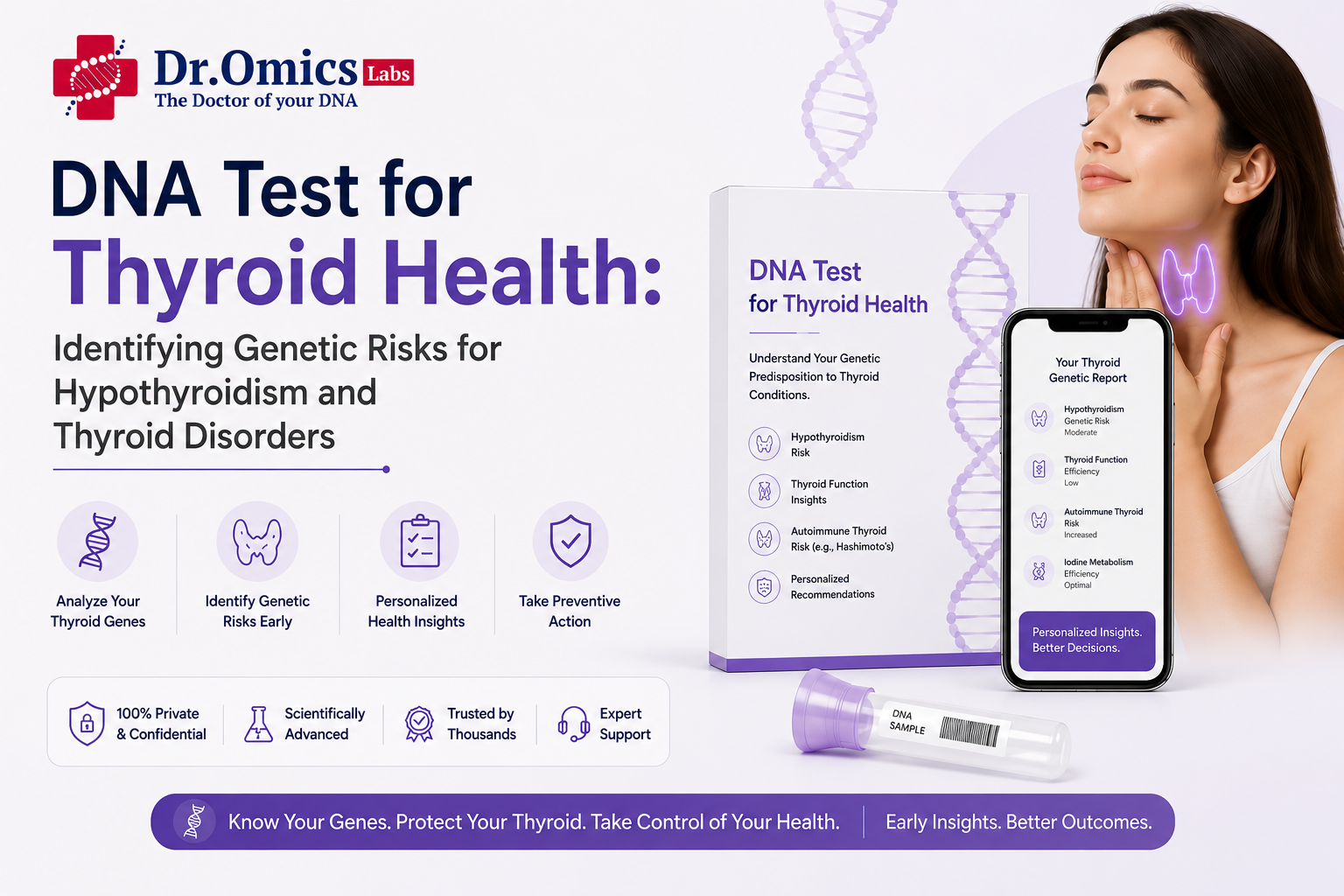
If you deal with persistent fatigue, unexplained weight gain, constant brain fog, or feeling unusually cold all the time, your first instinct is likely to check your thyroid. In India, thyroid disorders are incredibly common, affecting roughly 1 in 10 adults—with hypothyroidism leading the pack.
Typically, managing thyroid health involves a continuous cycle of reactive blood tests: measuring Thyroid Stimulating Hormone (TSH), Free T3, and Free T4 levels, followed by adjusting daily hormone medication dosages. However, standard blood panels only tell you your current hormone levels. They cannot explain why your thyroid is struggling or predict your long-term risks.
With the advent of autoimmune thyroid genomics, a specialized DNA test for thyroid India offers a way to look deeper. By examining your underlying DNA, you can uncover structural vulnerabilities before your blood markers spike. Here is everything you need to know about thyroid disorder genetic testing.
The Molecular Roots: Unpacking Thyroid Genetics
Your thyroid gland is a tiny, butterfly-shaped organ in your neck that acts as your body’s master metabolic engine. How efficiently it constructs hormones, responds to brain signaling, and converts those hormones into usable cellular energy is entirely dictated by your genetic code.
When we talk about thyroid genetics, several core pathways influence your risk for disorders like hypothyroidism:
[Brain: TSH Signalling (TSHR Gene)] —> [Thyroid Gland: Development (FOXE1 Gene)] —> [Peripheral Tissue: Activation (DIO2 Gene)]
When you undergo a comprehensive genetic thyroid risk test, clinical labs look at specific variations within high-priority gene clusters:
- TSH Genetics & Receptor Variations ($TSHR$): The TSHR gene tells your body how to build receptors that listen to Thyroid Stimulating Hormone (TSH). If your TSHR variants are less sensitive, your brain has to pump out significantly more TSH just to get a standard baseline response, a condition directly linked to subclinical or congenital hypothyroidism.
- Gland Development & Structure ($FOXE1$ & $NKX2-1$): Genetic markers like FOXE1 (Forkhead Box E1) and NKX2-1 rule the physical development and placement of your thyroid gland during embryogenesis. Faulty variations can lead to a smaller or poorly structured gland, reducing its natural lifetime output.
- Peripheral Hormone Conversion ($DIO2$): The thyroid primarily produces T4, an inactive storage form of the hormone. Your tissues must convert T4 into active T3 using an enzyme coded by the DIO2 gene. Variations in DIO2 can impair this conversion process. This means your standard blood test might show a “normal” T4 level, yet your cells are functionally starved for T3, explaining why some patients still feel exhausted despite normal clinical lab sheets.
Autoimmune Underpinnings: Hashimoto’s & Graves’
The vast majority of chronic hypothyroidism cases in developed and urban areas across India are caused by an autoimmune condition called Hashimoto’s Thyroiditis. In this scenario, the thyroid gland itself isn’t broken; instead, an overactive immune system misidentifies thyroid tissue as a foreign threat and attacks it with antibodies.
An advanced hypothyroidism DNA test India panel screens for human leukocyte antigen (HLA) complexes, specifically HLA-DR variants, alongside immune regulators like CTLA4 and PTPN22. Identifying these variants tells you if you carry a high genetic propensity for autoimmune thyroid disease, allowing you to implement targeted anti-inflammatory dietary and lifestyle modifications before irreversible glandular damage occurs.
What a Comprehensive Thyroid Gene Panel India Covers
Unlike standard, isolated single-gene tests, modern genomic testing leverages Next-Generation Sequencing (NGS) to run a comprehensive thyroid gene panel India profile.
How the Testing Process Unfolds
Getting a predictive genetic screening is entirely non-invasive and can be initiated easily from home.
1.Kit Collection & Activation:Discreet Logistics.
You receive an at-home genetic collection kit containing a sterile cheek swab or saliva stabilization vial. You register the unique kit code online to protect your identity.
2.Non-Invasive Sample Capture:Takes 60 Seconds.
You complete a simple cheek swab or fill the saliva vial, securing your cellular material without any painful blood draws or clinic waiting rooms.
3.Next-Generation Sequencing:Laboratory Sequencing.
The lab extracts your DNA and sequences your custom thyroid panel, cross-referencing your variants against massive global and Indian genomic databases.
4.Report & Functional Mapping:Precision Action.
You receive a color-coded genetic report detailing your metabolic roadblocks, which you can share with an endocrinologist to map out target-specific lifestyle changes or medical screening intervals.
The Precision Medicine Advantage: Your DNA sequence remains completely identical throughout your entire life. Investing in a thyroid genetic test gives you a definitive, foundational map that completely eliminates the trial-and-error approach to long-term metabolic health management.
Take Charge of Your Metabolic Health
Your genetic predispositions are not a definitive medical guarantee that you will develop a clinical disorder. Instead, they serve as a powerful biological warning system.
By utilizing thyroid disorder genetic testing, you gain the foresight needed to track your blood markers more closely, protect your metabolism, and make proactive choices that support your long-term healthspan.

