
For decades, elite sports scouted talent through a traditional lens: scouts watched games, measured sprint times, and tracked physiological outputs. If an athlete had the right instinct and raw physical power, they were deemed to have “it.” However, as the margin between winning gold and going home empty-handed shrinks to mere milliseconds, major sports federations are looking deeper. They are looking at the cellular level.
The field of sports genomics has evolved far beyond simply finding a child with “good genetics.” Today, elite sporting organizations across the globe are integrating comprehensive athlete DNA test panels into their training ecosystems. The goal is no longer just finding the next generation of superstars—it is about keeping them healthy, optimizing their training efficiency, and extending their professional lifespans.
Moving Beyond the Myth of “Sports Talent DNA”
Early discussions around genetics in sports often revolved around discovering unique sports talent DNA. Federations hoped to find a single genetic marker that would guarantee championship potential. However, elite human physiology is far too complex for that.
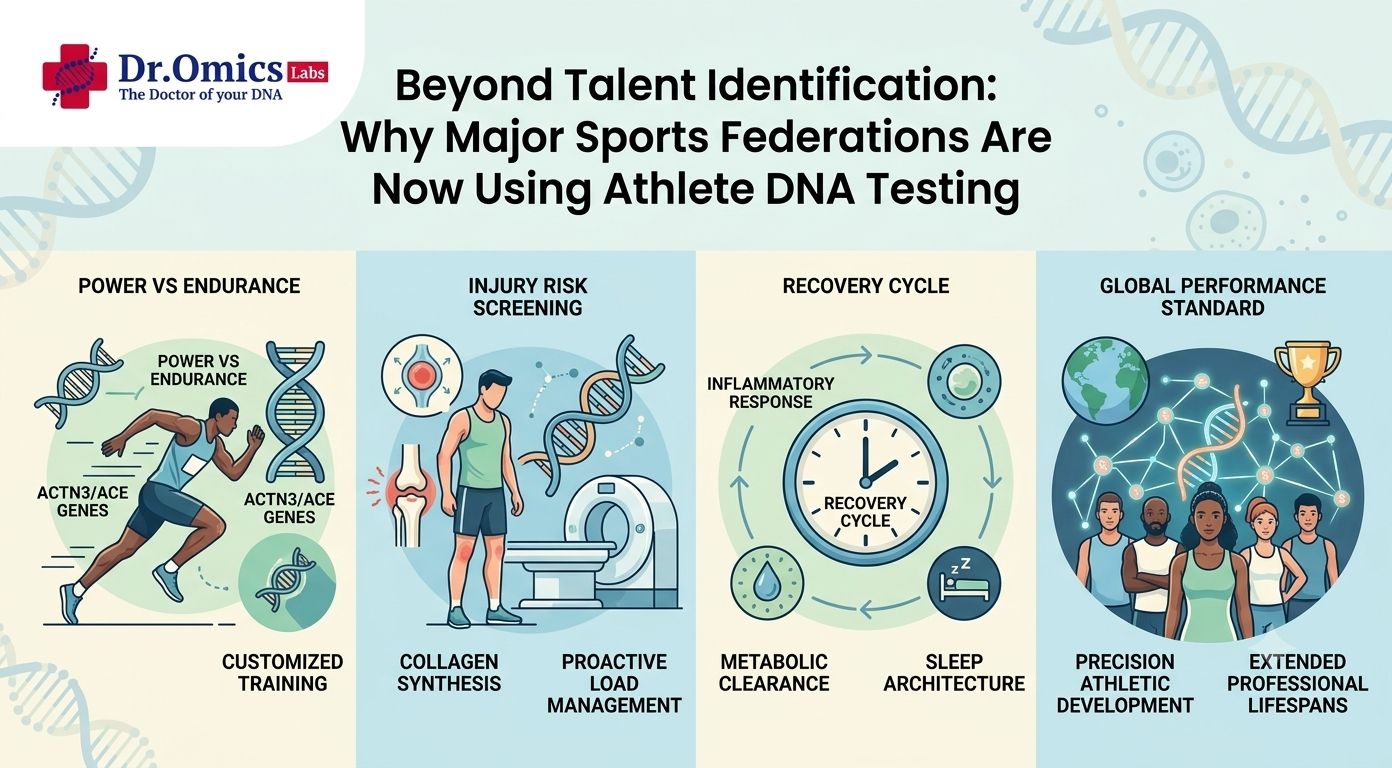
Modern athletic organizations use a sport DNA test not as a filter to discard players, but as a manual to refine them. For instance, an elite team may run an ACTN3 gene test alongside an ACE gene test on their entire roster. Understanding a player’s endurance vs power genetics helps coaching staffs make highly granular adjustments to their training loads. If a player is genetically predisposed to explosive power but possesses lower natural aerobic endurance, their conditioning drills are tailored to maximize that biological advantage rather than forcing them into a generic, counterproductive regimen.
Precision Training and Injury Prevention
At the highest tier of sports, an injury to a star player doesn’t just impact the scoreboard; it can cost millions of dollars and derail an entire franchise’s season. This financial and competitive pressure is why federations heavily rely on an injury risk DNA test.
By evaluating variations in genes responsible for structural collagen synthesis and soft-tissue elasticity, sports medical staffs can identify individuals highly vulnerable to ligament tears or tendonitis.
- Customized Strength Training: Utilizing data from a muscle genetics test allows trainers to build targeted stabilization routines around vulnerable joints.
- Proactive Load Management: If a player’s fitness DNA test indicates a sluggish structural repair mechanism, high-impact training volume is strictly monitored.
This level of genetic fitness testing shifts the paradigm from treating an injury to entirely preventing its onset.
Revolutionizing the Recovery Cycle
The true secret weapon of major sports federations isn’t how hard their athletes can train, but how efficiently they can recover. A recovery genetics test provides precise visibility into an athlete’s inflammatory response, oxidative stress levels, and metabolic waste clearance rates.
| Metric Monitored | Impact on Elite Athlete Ecosystem |
| Inflammatory Markers | Dictates whether an athlete needs immediate cryotherapy or active mobility post-game. |
| Metabolic Clearance | Informs nutritionists on specific micronutrient timing to accelerate tissue repair. |
| Sleep Architecture Genetics | Helps performance coaches build personalized sleep schedules during demanding travel phases. |
The New Standard of High Performance
By integrating a workout genetics test into their baseline medical screenings, major sports federations are establishing a new standard for high-performance management. Relying on DNA for sports performance is the ultimate tool for personalized athletic development. It allows organizations to respect individual biological boundaries while pushing the absolute limits of human capability. In the modern era of sports science, talent might get you into the league, but leveraging genomic data is what keeps you at the top.

