
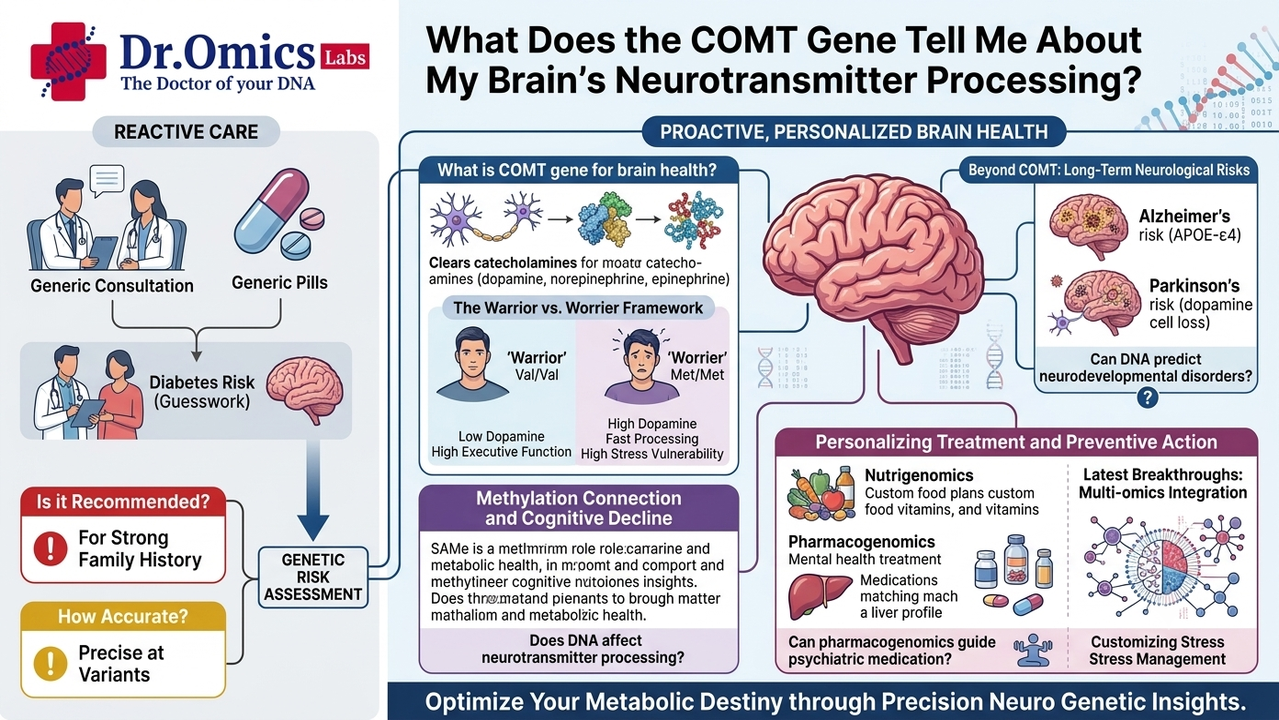
Have you ever wondered why some people thrive under intense pressure while others freeze, or why certain minds recall details effortlessly while others struggle? The answer isn’t just a personality trait—it is deeply rooted in your neurochemistry. Specifically, it heavily involves how does DNA affect neurotransmitter processing. At the center of this biological framework sits a critical biological marker: the COMT gene.
What is COMT Gene for Brain Health?
The COMT (Catechol-O-methyltransferase) gene provides instructions for making an enzyme that breaks down catecholamines—essential neurotransmitters including dopamine, epinephrine, and norepinephrine. Understanding what is COMT gene for brain health means looking closely at the prefrontal cortex, the brain region responsible for planning, executive function, decision-making, and focus.
Unlike other areas of the brain, the prefrontal cortex relies almost entirely on the COMT enzyme to clear out dopamine. If your COMT enzyme is highly active, it clears dopamine rapidly; if it is sluggish, dopamine lingers, fundamentally altering your cognitive baseline and emotional resilience. This creates the well-known “Warrior vs. Worrier” genetic profile:
- The Warriors (Val/Val Variant): High enzyme activity clears dopamine fast. These individuals process stress efficiently and stay calm under fire, but may require more stimulation to maintain optimal focus.
- The Worriers (Met/Met Variant): Low enzyme activity allows dopamine to linger. These individuals possess naturally higher baseline focus, memory retention, and cognitive performance under normal conditions, but easily overload and experience anxiety under acute stress. Knowing your profile shows you exactly how to use genetics for stress management.
The Methylation Connection and Cognitive Decline
To accurately understand how to interpret neuro genetic results, one must grasp what is methylation in brain health. Methylation is a vital biochemical process where small chemical tags are added to molecules to regulate gene expression and metabolize compounds. Because the COMT enzyme strictly requires a methyl donor (S-adenosylmethionine or SAMe) to function, any disruption in your wider methylation pathways directly impairs your brain’s ability to clear neurotransmitters.
Over time, these structural imbalances impact longevity. Evaluating how do genetics affect cognitive decline reveals that suboptimal methylation and dysregulated dopamine processing accelerate cellular fatigue, leaving the brain vulnerable to aging and affecting what genes affect memory and cognition.
Predicting Long-Term Neurological Risks
As modern healthcare shifts from reactive treatment to proactive prevention, individuals increasingly utilize what is genetic testing for brain health to discover their structural vulnerabilities. Patients frequently ask: can DNA predict Alzheimer’s risk or can DNA show Parkinson’s disease risk?
While a single variant like COMT primarily maps daily neurotransmitter processing, comprehensive panels look at multiple key neurological genetic markers simultaneously—such as the APOE-ε4 allele for Alzheimer’s or SNCA variations for Parkinson’s. Mapping these vulnerabilities early is an essential component of how a can DNA test guide dementia prevention strategy, empowering patients to make targeted behavioral, dietary, and biochemical shifts decades before clinical symptoms show up. Furthermore, these evaluations help determine if can DNA predict neurodevelopmental disorders or structural vulnerabilities early in life.
Personalizing Psychiatry and Treatment Protocols
The true magic of advanced diagnostics lies in actionable prevention. For individuals navigating mental health struggles, discovering how does genetics influence depression risk allows clinicians to move past traditional trial-and-error medicine. A targeted can DNA test guide mental health treatment by pinpointing precise pathways.
If medical intervention is required, understanding the patient’s metabolic framework answers the crucial question: can pharmacogenomics guide psychiatric medication? Through pharmacogenomics, doctors can see exactly how an individual’s liver enzymes and brain receptors respond to specific compounds, establishing whether a medication will work efficiently or cause adverse drug reactions.
Navigating Reliability and Next Steps
Before purchasing a kit, it is normal to ask: what neurological conditions can genetic testing detect, how accurate are neuro genetic tests, and is neuro genetic testing reliable?
Modern microarray and sequencing technologies are incredibly precise at identifying specific single nucleotide polymorphisms (SNPs). However, because lifestyle, diet, and stress management play massive roles, your DNA cannot deterministically dictate an exact onset age for diseases. Instead, the latest breakthroughs in neurogenomics involve integrating genomic risk with continuous biomarker tracking.
By trading a reactive mindset for precise genetic foresight, you can stop guessing about your neurological future and actively engineer a healthier, sharper brain.

