
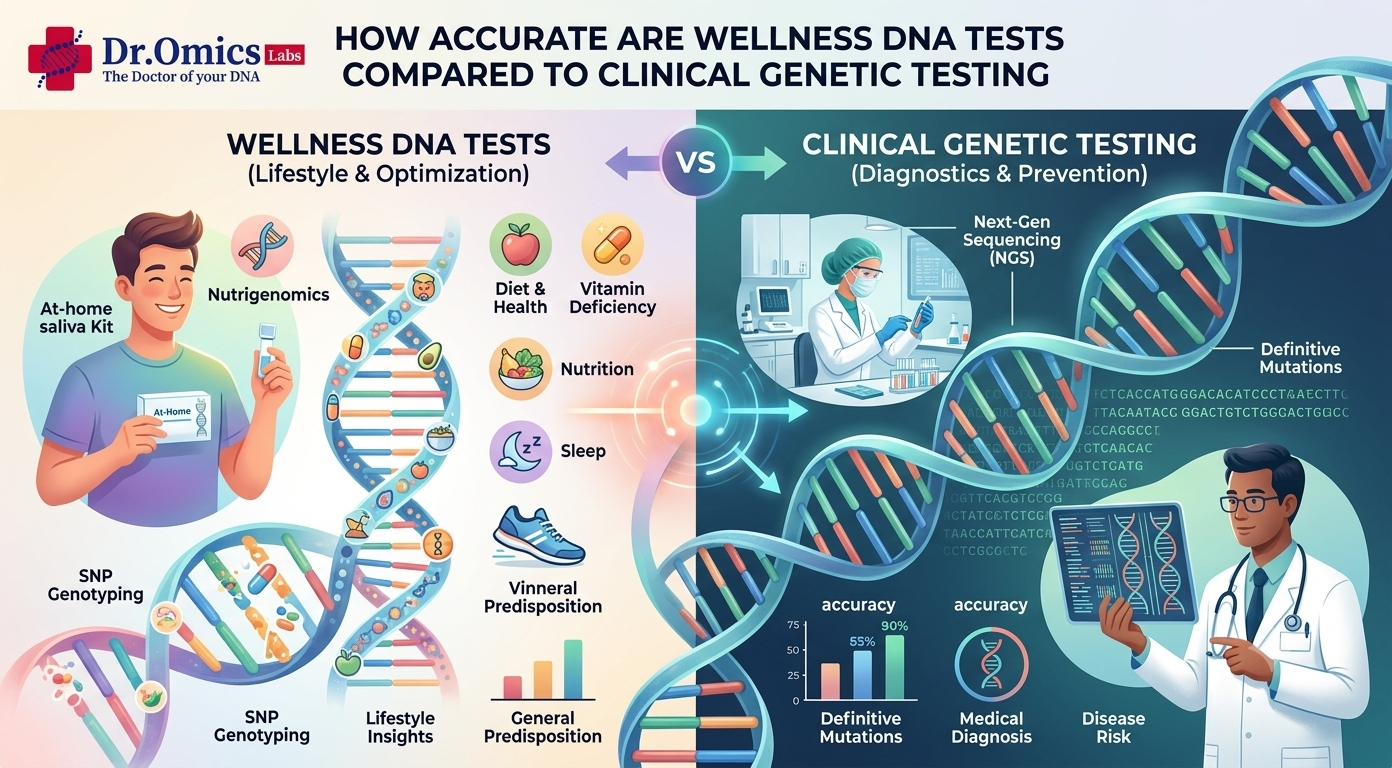
The genetic testing market has exploded. What started as a novelty to uncover ancestry has transformed into a massive industry promising to optimize every facet of our daily lives. But as we look at the landscape of how accurate are wellness DNA tests, a critical question arises: Can an at-home saliva kit truly compare to a medical-grade clinical genetic test?
To understand how to leverage these tools safely, we must break down the science behind the screens.
How Does a DNA Health Test Work?
To understand accuracy, you first need to know how does a DNA health test work.
At-home wellness tests typically use a method called genotyping. This process scans your DNA for specific, well-known variations called Single Nucleotide Polymorphisms (SNPs). Think of it like skimming a book for specific keywords.
In contrast, clinical genetic testing—ordered by a doctor—often uses Next-Generation Sequencing (NGS) to read entire genes or your whole genome letter by letter. Clinical tests look for rare, definitive mutations (like the BRCA genes for cancer), while wellness tests look at common variants that slightly alter your everyday traits.
What Can a Wellness DNA Test Tell Me?
If you are looking to optimize your day-to-day routine, a wellness test offers an intriguing starting point. It answers the fundamental question: what can a wellness DNA test tell me? Wellness testing focuses heavily on lifestyle optimization, including:
- Nutrigenomics testing: This field explores how your body uniquely metabolizes macronutrients, helping you understand how to personalize wellness with DNA.
- Vitamin and Food Sensitivities: It can reveal genetic tendencies, showing can DNA test show vitamin deficiencies (like absorption issues with Vitamin D) or can DNA test detect food intolerances (like lactose or caffeine sensitivity).
- Sleep and Aging: You can discover can DNA testing improve my sleep by looking at your circadian rhythms, or see how does genetics affect aging by tracking cellular repair capabilities.
Epigenetics and Longevity
Modern testing also dives into what is epigenetic testing. Unlike your fixed DNA code, your epigenome changes based on your environment. By measuring what does DNA methylation reveal, these tests provide a snapshot of your biological age versus your chronological age, highlighting what lifestyle changes based on DNA you should make to slow down the clock.
The Ultimate Showdown: Wellness vs. Clinical Testing
When assessing how accurate are wellness DNA tests, the reality is that they are highly accurate at reading your SNPs, but limited in their medical interpretation.
| Feature | Wellness DNA Testing | Clinical Genetic Testing |
| Primary Purpose | Lifestyle, diet, fitness optimization | Diagnosing medical conditions, hereditary diseases |
| Technology | SNP Genotyping (Skims specific markers) | Whole Gene Sequencing (Reads every letter) |
| Disease Prediction | Estimates broad, polygenic risk factors | Identifies definitive, high-risk pathogenic mutations |
| Medical Oversight | None (Direct-to-Consumer) | Required (Doctors & Genetic Counselors) |
Does DNA Testing Predict Disease Risk?
Many people buy kits wondering: does DNA testing predict heart disease risk or other chronic illnesses?
A wellness test can only provide a general predisposition. For instance, it might analyze what does my DNA say about inflammation to give you a broad score for cardiovascular risk. However, it cannot diagnose you. True preventive genetic testing worth it for medical peace of mind relies on clinical-grade labs to confirm high-risk health conditions.
Safety, Trust, and Advanced Horizons
Is genetic testing for health safe? Physically, yes—it only requires saliva or a cheek swab. However, you must ask: can at home DNA testing be trusted? While the laboratory data is generally reliable, direct-to-consumer reports lack clinical context. Misinterpreting your data can cause unnecessary anxiety or a false sense of security.
Furthermore, advanced fields like how does pharmacogenomics work—which analyzes how your genes affect your response to medications—should always be handled in a clinical setting under professional guidance.
Final Verdict: How to Interpret DNA Wellness Results
When learning how to interpret DNA wellness results, think of your wellness DNA test as a compass, not a map. It is excellent for tweaking your diet, fine-tuning your workouts, and understanding your body’s natural tendencies.
However, if you are looking to detect major health conditions, always opt for clinical testing. Treat at-home insights as a motivational tool to upgrade your lifestyle, but consult a physician before making any radical medical decisions.

