
We have all been there: you are hitting the gym consistently, tracking your macros, and sleeping well, yet your progress has ground to a halt. When you hit a fitness plateau, it is easy to assume you just need to “work harder.” However, the answer might be written in your genetic code. Understanding how to optimize fitness with DNA is shifting the paradigm from trial-and-error to precision training.
Why Do Some Build Muscle Faster?
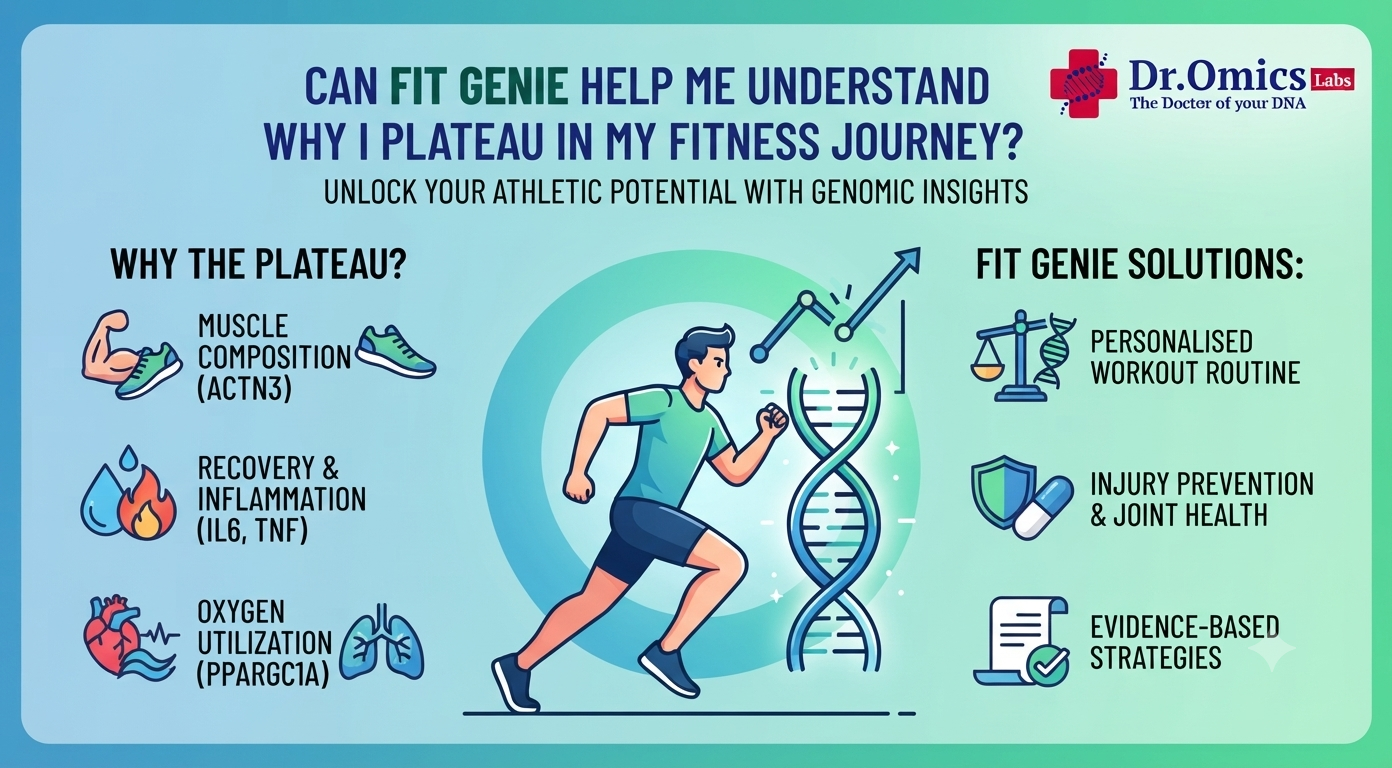
The reason some individuals experience rapid strength gains while others struggle is often rooted in genetic variations. Your DNA influences everything from how genetics affect muscle recovery to your body’s potential for explosive power. For instance, the ACTN3 gene for sprinters—often called the “speed gene”—encodes the $\alpha$-actinin-3 protein found in fast-twitch muscle fibers. If you possess the RR genotype, you are biologically wired for power and explosive movements; if you have the XX genotype, your body may be better adapted for endurance. Understanding your muscle fiber type test results through genetic insights allows you to tailor your training to your natural predispositions rather than fighting against your own biology.
Breaking the Plateau with Genetic Insights
When you reach a plateau, it is often a sign of a mismatch between your training load and your biological recovery capacity. A tool like Fit Genie can help explain fitness plateaus by analyzing your specific genetic profile, including markers for inflammation and oxidative stress.
- Recovery and Inflammation: What genes affect exercise inflammation? Variants in genes like IL6 and TNF regulate your inflammatory response. If you have a high genetic predisposition for inflammation, “standard” rest days may not be enough, and your body might stay in a state of chronic fatigue, causing your progress to stall.
- Oxygen Utilization: How does DNA affect oxygen utilization? Genes like PPARGC1A influence how efficiently your cells adapt to aerobic training. Knowing your genetic predisposition here helps determine how to use DNA for endurance training effectively.
- Injury Risk: What genes affect joint health? Markers such as COL1A1 and COL5A1 impact the structural integrity of your tendons and ligaments. If you are genetically prone to soft-tissue injuries, you may need to prioritize mobility over intensity to keep making progress.
Can DNA Personalize My Workout Routine?
Absolutely. By using genetics, you can move away from generic “one-size-fits-all” advice. Does DNA determine HIIT vs cardio? While lifestyle choices are paramount, your DNA provides a map of what training stimulus your body naturally responds to. Whether it is determining your best exercise based on DNA or assessing your overtraining risk, these insights ensure that every session counts toward your goal.
Are genetic fitness tests accurate and is Fit Genie test reliable? While no test can predict athletic greatness or replace hard work, professional-grade tests like Fit Genie provide high-value, data-driven insights by combining complex bioinformatics with actionable daily habits. When you combine DNA with fitness tests, you bridge the gap between “what is trending” and “what your body was built for”.
Conclusion
A fitness plateau is not a failure; it is a signal that your current strategy may not be aligned with your unique biological needs. By understanding your genetic markers for recovery, muscle composition, and inflammation, you can pivot your routine to work with your body rather than against it. While genetics are just one piece of the puzzle—alongside consistency, nutrition, and sleep—they offer the clarity needed to break through barriers and optimize your long-term athletic potential. If you are tired of the guessing game, leveraging your DNA profile might just be the key to unlocking your next level of performance.

