
When we witness elite athletes shattering world records, we often attribute their success to relentless grit, flawless nutrition, and hours of grueling practice. While hard work is entirely non-negotiable, sports science has revealed a deeper layer to human capability hidden within our cells. The rapidly growing field of sports genomics shows that our biological infrastructure plays a massive role in how we respond to training.
By analyzing specific variations through an athlete DNA test or a comprehensive sport DNA test, we can map out individual physical predispositions. Rather than relying on generic workout trends, understanding your personal athletic performance genetics provides the ultimate playbook to align your training with your DNA.
The Dynamic Duo of Athletic Performance: ACTN3 and ACE
At the core of genetic performance testing are two of the most heavily researched genetic markers in sports history: ACTN3 and A_C_E.
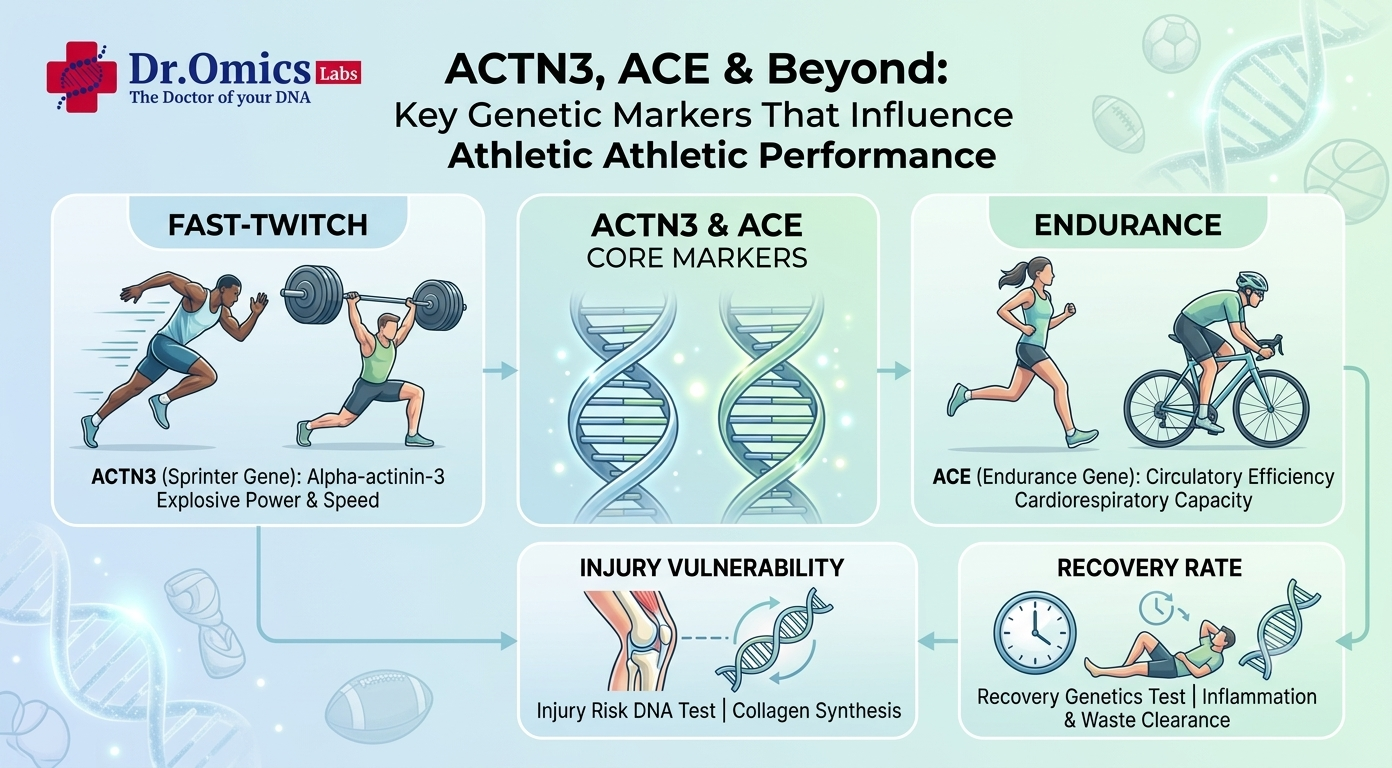
An ACTN3 gene test looks closely at a gene responsible for producing alpha-actinin-3, a specialized structural protein found exclusively in fast-twitch muscle fibers. These fibers generate the rapid, explosive force required for sprinting, lifting weights, and jumping. A functional variation of this gene means your muscles are biologically optimized for speed and raw power.
Conversely, an ACE gene test evaluates an enzyme marker deeply linked to cardiorespiratory endurance and circulatory efficiency. Certain variations of the A_C_E gene allow for enhanced oxygen utilization and superior blood flow regulation. Unlocking these specific traits through a targeted muscle genetics test gives athletes absolute clarity on where they sit on the spectrum of endurance vs power genetics.
Beyond Power: Injury Vulnerability and Recovery Pacing
True physical mastery isn’t just about how fast you can run or how much weight you can lift; it is also about how long your body can sustain that stress without breaking down. This is where an injury risk DNA test becomes an indispensable asset. Your genes dictate the structural integrity of your ligaments, tendons, and joints by managing how your body synthesizes collagen. Identifying inherent soft-tissue vulnerabilities allows you to add specific structural stabilization work into your routine.
Furthermore, a comprehensive fitness DNA test looks closely at your body’s unique inflammatory response. A specialized recovery genetics test tracks how quickly your tissues clear metabolic waste products after a demanding training block. If your cellular blueprint indicates an elevated inflammatory curve, a generic daily routine could easily land you in a state of chronic overtraining.
Tailoring Your DNA-Driven Routine
Discovering your genomic markers doesn’t mean discovering a single, definitive piece of sports talent DNA that guarantees victory. Instead, it serves as an individual manual for precision adaptation.
Using an integrated workout genetics test, you can design a routine optimized for your biology:
- High-Power Blueprints: Emphasize explosive resistance training with longer recovery windows.
- High-Endurance Blueprints: Prioritize steady-state cardio pacing and high-volume, lower-intensity conditioning.
- Sluggish Recovery Trait: Intentionally insert strategic active rest days, mobility sessions, and targeted nutritional timing.
Precision Training for Lifelong Success
Utilizing data-driven genetic fitness testing completely eliminates the trial-and-error approach to physical development. Investing in DNA for sports performance is the single best way to optimize your energy, lower your injury profile, and hit your fitness milestones safely. By matching your training volume and recovery protocols to your biological blueprint, you unlock sustainable athletic excellence.

