
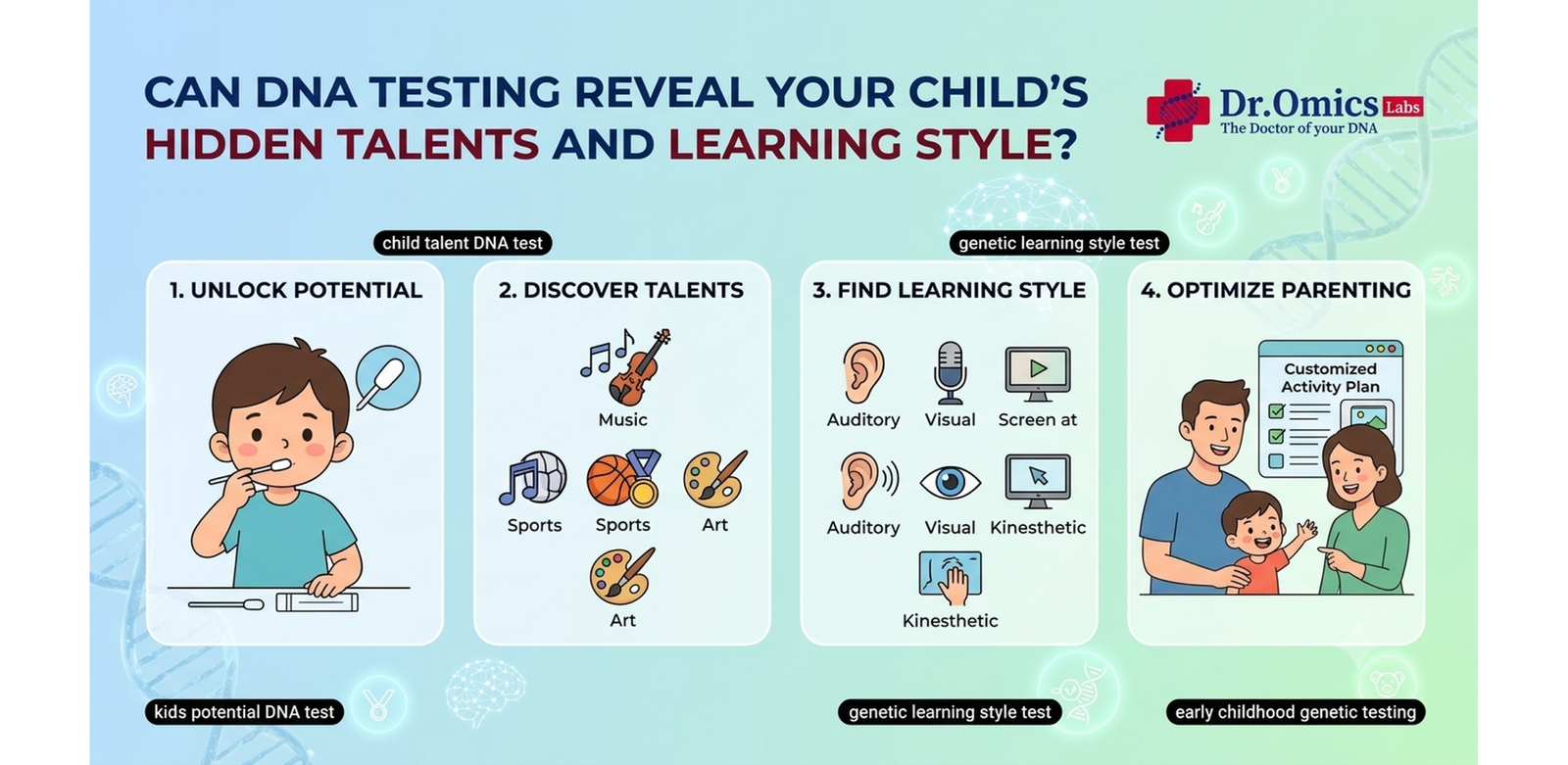
Every parent looks at their child and wonders about their boundless potential. Is my daughter destined to be a concert pianist, or a brilliant mathematician? Will my son thrive in a bustling, high-energy classroom, or does he need a quiet, independent study environment? For generations, figuring this out has been a journey of trial and error—enrolling kids in soccer, art, and coding until something clicks. But today, a modern frontier in science is offering parents a new lens: child talent DNA test.
By looking closely at a child’s unique genetic blueprint, these specialized screenings are changing how families approach education and personal growth. But how does it work, and what can it actually tell you?
Decoding the Blueprint: What is Early Childhood Genetic Testing?
Early childhood genetic testing involves a simple, painless cheek swab that analyzes specific variations (polymorphisms) in a child’s DNA. These genes are linked not to physical health diseases, but to behavioral traits, cognitive processing speeds, sensory responses, and athletic predispositions.
Science has shown that our genes do not dictate our destiny entirely—environment and parenting matter immensely. However, they do provide a roadmap of our natural tendencies. Understanding these predispositions early on allows parents to align their guidance with how a child is naturally wired to learn and grow.
Unlocking Academic Success with a Genetic Learning Style Test
Every child absorbs information differently, yet traditional schooling often relies on a one-size-fits-all approach. Some children are visual learners, others learn best by doing, and some require auditory repetition. A genetic learning style test helps bridge this gap by examining gene markers associated with:
- Information Processing Speed: How quickly a child processes new concepts and problem-solving tasks.
- Working Memory: Their capacity to retain and manipulate information in real-time.
- Attention and Focus: Genetic tendencies related to dopamine receptors, which can indicate how a child responds to stimulation and sustained concentration.
- Sensory Integration: How sensitive they are to environmental stimuli like bright lights or loud noises, which can heavily impact classroom performance.
When educators and parents understand these cognitive traits, they can tailor study habits to match the child’s strengths, reducing academic frustration and building lifelong confidence.
Discovering Innate Strengths Through a Kids Potential DNA Test
Beyond academics, every parent wants to nurture their child’s unique gifts. A kids potential DNA test dives into behavioral and physical predispositions, highlighting areas where a child might naturally excel.
For instance, genetic markers can point toward traits like endurance versus explosive power in athletics, artistic creativity, musical aptitude, or leadership potential. Rather than pushing a child into activities that lead to burnout, parents can use these insights to explore diverse hobbies that resonate with the child’s natural inclinations.
The Philosophy of DNA Based Parenting
It is crucial to understand that these tests are not crystal balls. They do not guarantee that your child will win an Olympic gold medal or become a Nobel laureate just because a gene is present. Instead, DNA based parenting is about personalization and empathy.
It helps parents become better guides by removing the guesswork. If your child’s genetics indicate a predisposition toward high impulsivity or quick frustration, you can adapt your communication style to foster patience and emotional regulation. It is about celebrating who your child is inherently, rather than molding them into a preconceived ideal.
Conclusion
Navigating parenthood is one of life’s greatest adventures, and we are always looking for ways to give our children the best head start possible. While genetic insights are still just one piece of the puzzle—alongside nurturing environments, education, and love—they offer a remarkable window into a child’s unique makeup. By embracing these scientific tools thoughtfully, parents can foster an environment where every child’s individual brilliance can truly shine.

