
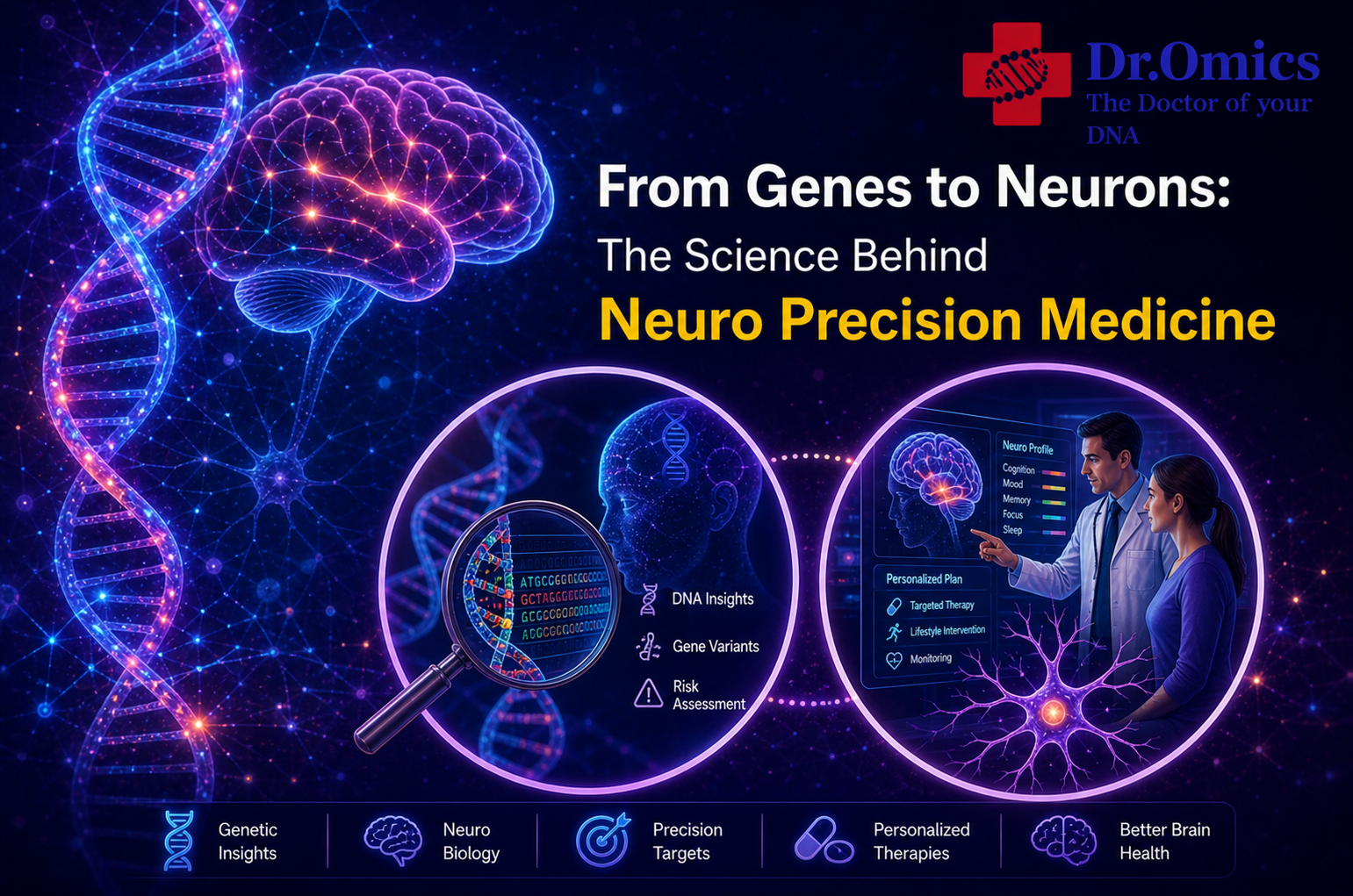
For decades, treating neurological conditions felt a bit like navigating a maze blindfolded. Two patients with the exact same diagnosis of migraines, epilepsy, or Alzheimer’s disease would often receive the same standard prescription. One might get better; the other might suffer side effects or see no improvement at all.
But the map has changed. We are currently witnessing a seismic shift in brain health, moving away from trial-and-error toward a targeted model known as **neuro precision medicine**. By bridging the gap between our DNA and brain function, doctors are now unlocking treatments tailored specifically to you. At the heart of this revolution lies **brain genomics**—the study of how your genetic code influences the structure and chemistry of your neurons.
The Blueprint of the Mind
To understand why this matters, you first have to understand the players. Your brain contains roughly 86 billion neurons. These cells communicate via synapses using chemical messengers called neurotransmitters. But what instructs these neurons to build receptors, produce enzymes, or clear out toxins? Your genes.
**Brain genomics** is the field that deciphers these instructions. It looks at specific variations in your DNA—single nucleotide polymorphisms (SNPs) and rare mutations—that dictate how your nervous system operates. For example, a specific gene variation might cause your neurons to clear dopamine too quickly, leading to focus issues. Another mutation might make your brain’s NMDA receptors hypersensitive, triggering chronic anxiety or neuroinflammation.
This is where the diagnostic tools get exciting. Enter the **DNA brain test**. Unlike a standard ancestry swab, a **neurological DNA test** is a clinical-grade analysis designed to look exclusively at genes relevant to the central nervous system.
From Swab to Synapse
How does a **neurological DNA test** work in practice? The process is non-invasive and surprisingly simple. A patient provides a saliva sample or a cheek swab. The lab then sequences specific panels of genes linked to neurology—such as those controlling the blood-brain barrier, neurotransmitter synthesis, or synaptic plasticity.
The resulting data is run through sophisticated bioinformatics algorithms. Instead of just telling you that you have the “MTHFR gene,” **neuro precision medicine** analyzes the *functional impact* of that gene. For instance, if your **DNA brain test** reveals a variant in the *BDNF* gene (Brain-Derived Neurotrophic Factor), it suggests your neurons may struggle with repair and growth. A clinician would then avoid medications that suppress neuroplasticity and instead recommend targeted supplements or cognitive exercises that boost this pathway.
Personalized Neurology in Action
The goal of **personalized neurology** is to stop asking “What disease do you have?” and start asking “What is the genetic root of your symptoms?”
Consider the case of treatment-resistant depression. Standard SSRIs work by blocking the reuptake of serotonin. But if a patient’s depression is actually driven by a mutation in the *MTHFR* gene (causing low folate in the brain) or the *COMT* gene (causing excess dopamine catabolism), an SSRI might actually make things worse by altering metabolic pathways incorrectly.
Through **neurogenetic testing**, a neurologist can see that the patient has a slow COMT enzyme. The **personalized neurology** approach would then prescribe a lower starting dose of a dopamine-modulating agent, or utilize specific methylated B-vitamins to support the enzyme’s function. The result is faster relief with fewer side effects.
Similarly, in epilepsy, **neurogenetic testing** can predict if a patient will have a severe reaction to carbamazepine (HLA-B*1502 allele) or if they carry a sodium channel mutation that makes traditional blockers useless.
The Future of Brain Genomics
The science is mature, but the application is rapidly accelerating. We are moving beyond reactive treatment into predictive care. Imagine a young adult with a family history of Huntington’s or Parkinson’s. A **neurological DNA test** cannot currently cure these conditions, but it can identify biomarkers years before symptoms appear. This allows for lifestyle changes, neuroprotective supplements, and monitoring that can delay onset by a decade or more.
Furthermore, pharmaceutical companies are using **brain genomics** to design clinical trials. Instead of testing a new Alzheimer’s drug on 2,000 random patients (where it might fail because only 200 have the specific amyloid pathway issue), they recruit only those with the genetic markers for that pathway. This is the essence of **neuro precision medicine**: right drug, right patient, right time.
What You Should Do Next
If you suffer from chronic migraines, memory fog, mood disorders, or neuropathy that hasn’t responded to standard care, ask your provider about **neurogenetic testing**. While not every insurance covers it yet, the cost of a comprehensive **DNA brain test** has dropped from thousands of dollars to a few hundred.
However, a word of caution: raw genetic data is just noise without interpretation. Only a clinician trained in **personalized neurology** can distinguish between a benign variant and a pathological one. Do not upload your raw data to a random website for health advice; work with a neurologist who understands **brain genomics** to translate your DNA into actionable treatment plans.
The Synaptic Takeaway
The era of guessing is ending. **Neuro precision medicine** represents the logical conclusion of modern science: treating the brain based on its biological truth, not its surface symptoms. By utilizing a **neurological DNA test** to guide **personalized neurology**, we are finally learning the language of the neuron—and writing prescriptions that speak it fluently.
Your genes are not your destiny; they are a blueprint. And for the first time in history, we have the tools to read that blueprint and build a healthier brain.