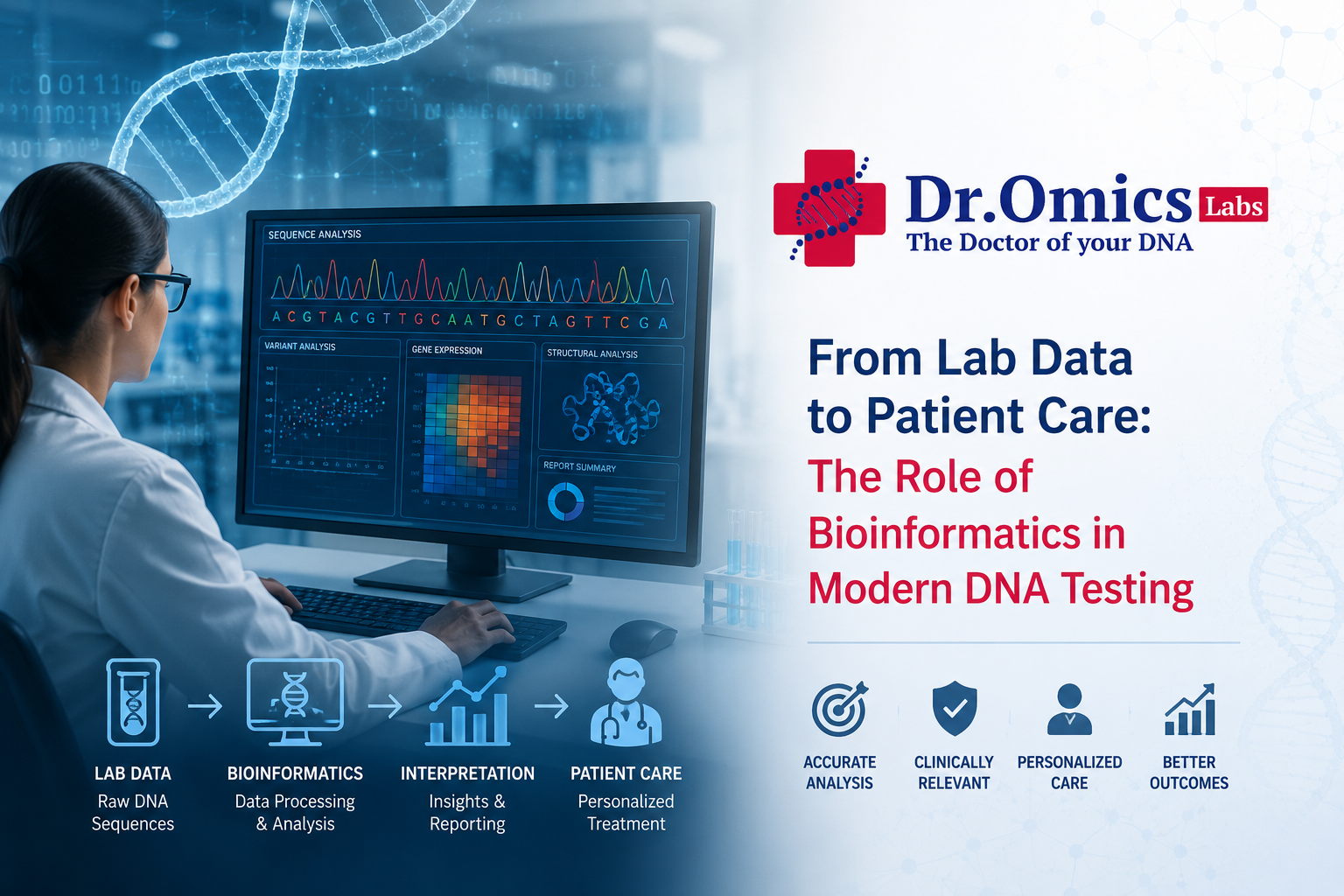
In the popular imagination, a DNA test is a simple process: a swab of the cheek, a whirring machine, and a printed report that reveals your ancestry or health risks. However, the reality of 2026 is far more sophisticated. Between the collection of a biological sample and the final medical consultation lies a complex, invisible bridge known as bioinformatics.
As genomic technology advances, we are no longer limited by our ability to sequence DNA; we are limited only by our ability to understand it. This is where clinical bioinformatics workflows become the heartbeat of modern medicine, transforming raw biological noise into life-saving clinical insights.
The Data Deluge: Why We Need Bioinformatics
A single human genome consists of approximately 3 billion base pairs. When a DNA test service provider sequences a patient’s sample, the machine produces terabytes of raw data—essentially a massive, jumbled library of the letters A, C, T, and G.
Without genomic data analysis, this information is useless. Bioinformatics is the multidisciplinary field that combines biology, computer science, and statistics to organize this “big data.” It acts as a digital translator, identifying which of those 3 billion letters are standard and which are variants that might indicate a predisposition to disease.
Dr. Omics: Revolutionizing Clinical Bioinformatics Workflows
In the landscape of 2026, specialized entities like Dr. Omics are leading the charge in streamlining the transition from lab to clinic. Dr. Omics services represent the gold standard in bioinformatics in diagnostics, providing the computational infrastructure that smaller labs and hospitals often lack.
A typical clinical workflow powered by these services involves several high-stakes steps:
- Quality Control: Ensuring the raw data is accurate and free from laboratory artifacts.
- Alignment: Comparing the patient’s DNA fragments against a “reference genome” to see where they differ.
- Variant Calling: Highlighting specific mutations (variants) that deviate from the norm.
- Annotation: The most critical step—cross-referencing those variants against global medical databases to determine if they are “benign,” “pathogenic,” or “of unknown significance.”
By automating these steps, service providers ensure that the path to a diagnosis is both rapid and reproducible.
Precision Diagnostics: Beyond the “Average” Patient
The true power of bioinformatics in diagnostics lies in its ability to facilitate precision medicine. In the past, medical treatments were designed for the “average” patient. Today, genomic data analysis allows doctors to treat the individual.
For example, in oncology, bioinformatics tools can analyze the DNA of a tumor and compare it to the patient’s healthy DNA. This reveals the specific genetic drivers of the cancer, allowing oncologists to select “targeted therapies” that attack the tumor while sparing healthy cells. This level of granularity would be impossible without the sophisticated algorithms developed by bioinformatics experts.
The DNA Test Service Provider: Choosing Quality Over Price
As DNA testing becomes a commodity, the differentiator for a DNA test service provider is no longer just the sequencing machine—it is the quality of their bioinformatics pipeline.
A high-quality provider doesn’t just give you a list of mutations; they provide a curated, interpreted report. This is why partnerships with specialists like Dr. Omics are so vital. They bridge the gap between “data” and “wisdom.” When a clinician receives a report, they need to know that the variants identified have been filtered through the latest peer-reviewed research and validated by robust clinical bioinformatics workflows.
Overcoming the “VUS” Challenge
One of the biggest hurdles in modern genomics is the “Variant of Uncertain Significance” (VUS). This is a genetic change where the medical community doesn’t yet know if it causes disease or is simply a harmless quirk of individuality.
Bioinformatics is solving this through predictive modeling. Using AI and machine learning, bioinformaticians can now simulate how a specific mutation might affect the shape and function of a protein. This gives clinicians a “probability score” for a VUS, helping them make more informed decisions even when the clinical data is still emerging.
The Future: Integrating “Multi-Omics”
The field is already moving beyond just DNA. The next frontier in patient care involves integrating “multi-omics”—combining DNA data (Genomics) with RNA data (Transcriptomics) and protein data (Proteomics).
This holistic view provides a real-time map of a patient’s health. While your DNA (the blueprint) stays the same, your RNA and proteins (the active construction) change based on your diet, stress, and environment. Processing this multi-layered data requires the next generation of Dr. Omics services, pushing the boundaries of what computers can do for human health.
Conclusion: The Human Element in a Digital World
Despite the heavy reliance on algorithms and supercomputers, the goal of bioinformatics remains deeply human. It is about providing a parent with an answer for their child’s undiagnosed condition, helping a patient find a cancer treatment that actually works, and giving healthy individuals the knowledge to stay that way.
The journey from lab data to patient care is complex, but it is the most important journey in modern medicine. Through genomic data analysis and expert clinical bioinformatics workflows, we are turning the “code of life” into a roadmap for a longer, healthier future. If you are looking for a DNA test service provider, remember: the magic isn’t in the swab—it’s in the math.