
You finally did it. You ordered a home genetic testing kit, spat into a vial or completed a cheek swab, and waited weeks for the lab to sequence your cells. Now, the notification pops up in your inbox: Your genomic results are ready.
You download the PDF, open it with excitement, and immediately freeze. Your screen fills with complex acronyms, decimal numbers, colorful risk bars, and terms like “rsID” or “heterozygous variant.” Suddenly, it feels like you need a Ph.D. in molecular biology just to understand your own body.
If you are looking at a screen full of data and wondering how to read a DNA test report India-wide, don’t worry. A DNA report explained in simple terms is highly intuitive once you know the basic architecture. Here is a beginner’s roadmap to understanding genetic reports without the medical jargon.
1. The Raw Material: SNP Analysis Explained
To figure out what does DNA test result mean, you first need to look at what the laboratory actually analyzed. Human beings share roughly 99.9% of their genetic code. The remaining 0.1% is what makes you entirely unique—dictating your eye color, height, metabolism, and health vulnerabilities.
The core of consumer and wellness genomics relies on SNP analysis explained simply as tracking “Single Nucleotide Polymorphisms” (pronounced snips). A SNP is a tiny typo or spelling variation at a single, specific position in your DNA sequence.
When you look at your report, you might see a technical label like rs1801133. That “rsID” is simply a universal registry number that acts like a GPS coordinate, pointing scientists to the exact spot on your genome where a variation was measured.
Understanding Your Genotype
For every coordinate, you inherit one letter (allele) from your mother and one from your father. Your report will often show your specific combination:
- Wild Type (Typical): You inherited two copies of the common, standard letter (e.g., CC). This usually represents a standard baseline risk.
- Heterozygous Variant: You inherited one standard letter and one mutated letter (e.g., CT). Your cellular pathway might be moderately altered.
- Homozygous Variant: You inherited two copies of the mutated letter (e.g., TT). This pathway’s efficiency could be significantly increased or decreased.
2. Polygenic Risk Score India: The Big Picture
When checking for common health metrics—like your predisposition to weight gain, cholesterol shifts, or sleep depth—looking at a single gene isn’t enough. These traits are polygenic, meaning they are influenced by thousands of tiny genetic variations acting simultaneously.
This is where the genetic risk score meaning comes into play, often represented in modern reports as a Polygenic Risk Score (PRS) India panel.
[Individual SNPs: rs1801133 + rs9939609 + rs174537…]
│
▼
Combined into an Algorithmic Total
│
▼
[Your Final Polygenic Risk Score (PRS)] —> Low / Average / High Risk Tier
Instead of confusing you with isolated data points, an algorithm combines the mathematical weights of all your individual SNPs into a single score. This score is then benchmarked against a reference population—ideally an Indian genomic database—to tell you where you stand compared to average baselines.
3. Navigating the Core Sections of Your Report
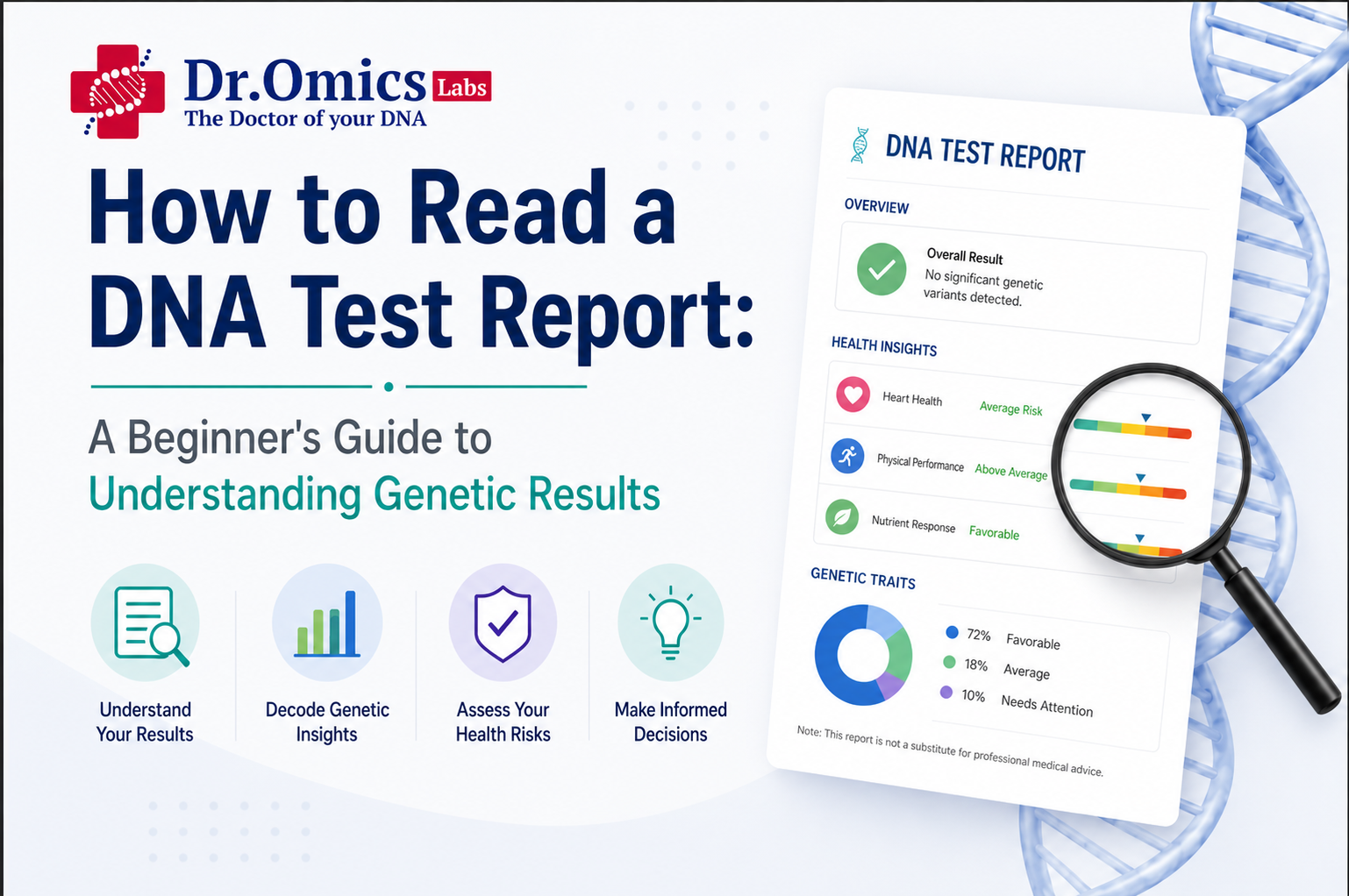
Most wellness and preventive genomics platforms use a scannable, color-coded structure to make genomics report interpretation as user-friendly as possible:
4. Distinguishing Between Predisposition and Destiny
The single most critical step in understanding genetic reports is keeping your results in perspective.
A Gene is a Vulnerability, Not a Mandate: A high genetic risk score for a condition like high LDL cholesterol or low vitamin absorption does not mean you have a medical diagnosis. It simply indicates a structural bottleneck in your baseline chemistry.
Your genes load the gun, but your environment, daily nutrition, sleep hygiene, and physical activity pull the trigger. Knowing your genetic vulnerabilities allows you to modify your lifestyle habits to prevent those genes from expressing themselves negatively.
The Next Step: Turn Data Into Actions
Reading your report is only half the battle; the true value lies in execution. Use your DNA insights as a data-backed blueprint to guide your grocery shopping, supplement selections, and exercise strategies. If your report flags complex clinical risks, consider booking a session with a certified genetic counselor or a functional medicine doctor to build a highly targeted lifestyle plan.

