
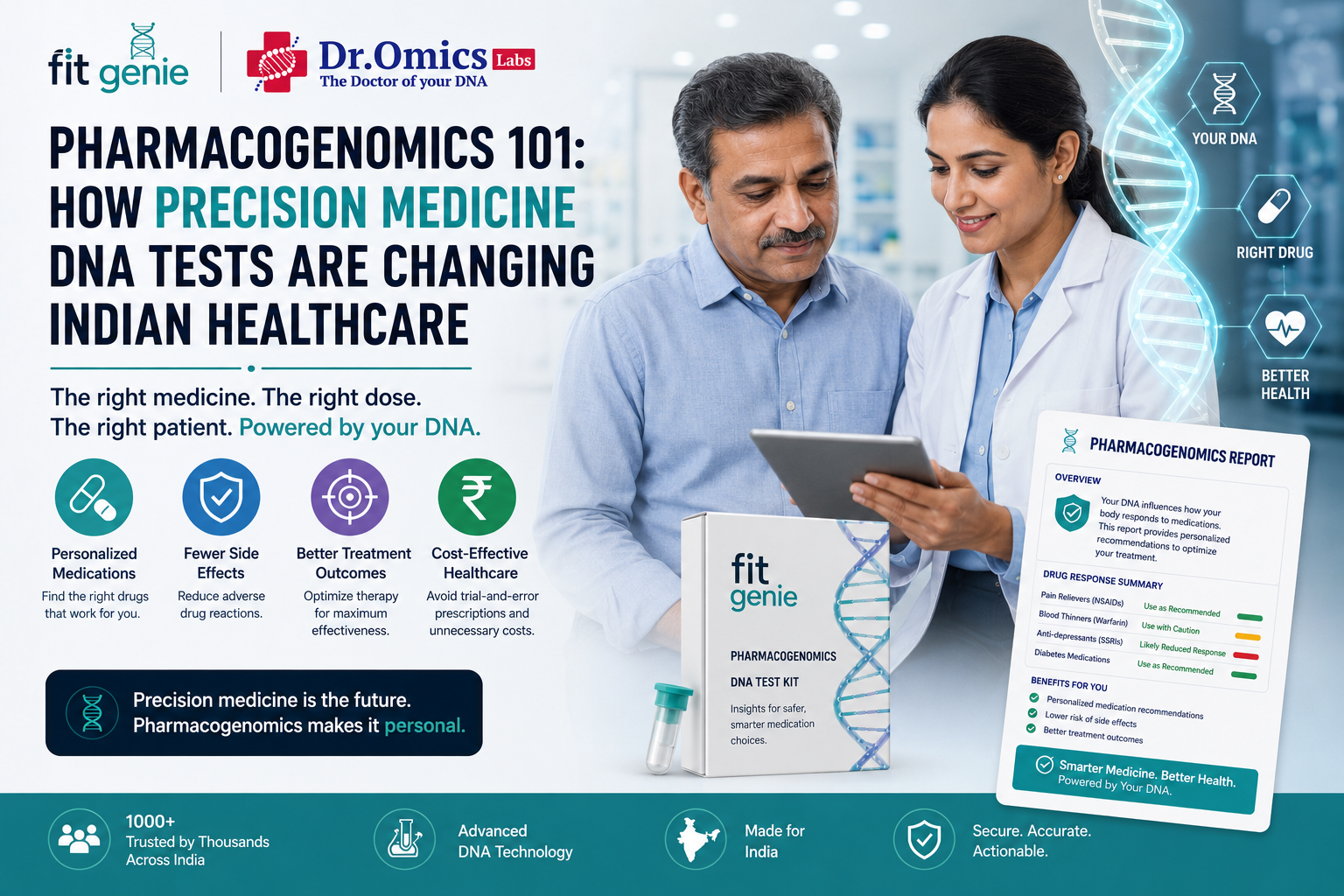
Imagine walking into a clinic, being prescribed a standard medication for high blood pressure or depression, and instead of recovering, you experience debilitating side effects. Worse yet, what if the drug simply does not work? For decades, the global medical community—including India—has relied on a “one-size-fits-all” approach to treatment. Doctors prescribe medications based on generalized clinical trials, which historically underrepresented Indian populations.
However, a quiet revolution is happening in Indian diagnostics. Enter pharmacogenomics India, a rapidly advancing field that is shifting healthcare from standard guessing games to highly tailored, predictive treatments. By analyzing how your unique genetic makeup influences your reaction to drugs, a precision medicine DNA test is radically altering the clinical landscape.
Here is everything you need to know about how personalized medicine India is moving from a luxury scientific concept into everyday hospital care.
What is Pharmacogenomics (PGx)?
At its core, pharmacogenomics (often abbreviated as PGx) is the intersection of pharmacology (the science of drugs) and genomics (the study of genes). While our human DNA is 99.9% identical, that remaining 0.1% accounts for staggering differences in how our bodies process foreign substances.
When you swallow a pill, your liver utilizes specific enzymes to break it down. Your DNA holds the exact blueprint for these enzymes. A pharmacogenetics test India decodes these blueprints to reveal whether you are:
- Poor Metabolizers: You break down drugs too slowly, leading to a dangerous buildup of the chemical in your bloodstream, causing severe adverse drug reactions (ADRs).
- Ultra-rapid Metabolizers: You clear the drug so quickly that it never has a chance to work, rendering standard doses completely ineffective.
By identifying these traits beforehand, doctors can practice true gene-based drug therapy, ensuring you get the right drug at the right dosage on the very first try.
The Danger of “One Size Fits All” and Drug-Gene Interactions
Every year, thousands of hospital admissions in India are driven by adverse drug reactions. The culprit behind many of these incidents is a hidden drug gene interaction.
For example, consider the commonly prescribed blood thinner, Clopidogrel, given to prevent strokes and heart attacks. To work, Clopidogrel must be activated by a specific liver enzyme called CYP2C19. Research shows that a significant percentage of the Indian population carries genetic variants that make them poor metabolizers of this enzyme. If given a standard dose, their bodies cannot activate the medicine, leaving them highly vulnerable to a recurrent, life-threatening blood clot.
Similarly, certain communities within India carry unique mutations. For instance, studies have shown that a mutant form of the BCHE gene—which makes it impossible to metabolize specific anesthetic drugs, causing temporary muscle paralysis—is vastly more prevalent in certain South Indian communities due to historical genetic isolation and endogamy (marrying within the community). Without precision genomics, exposing these patients to standard surgical anesthesia can lead to medical emergencies.
How PGx Testing India is Revolutionizing Chronic Care
The clinical utility of a precision medicine DNA test spans multiple high-stakes medical fields across Indian hospitals:
1. Oncology (Cancer Care)
Chemotherapy is notoriously punishing. In treatments using drugs like Fluorouracil (5-FU) or Capecitabine, patients with a genetic deficiency in the DPYD gene can experience life-threatening toxicity. Pre-treatment genetic screening allows oncologists to adjust dosages or pick alternative therapies, saving lives before a single drop of chemo is administered.
2. Psychiatry and Mental Health
Finding the right antidepressant or antipsychotic is famously tedious, often requiring months of exhausting trial-and-error. PGx testing India maps out how a patient will respond to SSRIs or anti-anxiety medications, avoiding months of therapeutic frustration, worsening depression, and unexpected side effects.
3. Cardiology
From managing cholesterol with statins (which can cause severe muscle pain in genetically predisposed individuals) to optimizing blood thinners like Warfarin, precision mapping keeps cardiovascular patients stable without the fear of internal bleeding or sudden clots.
The Indian Context: The Power of Population Genetics
For a long time, the global databases used for personalized medicine India were heavily flawed—over 60% of their samples came from individuals of European descent. Because drug-response genes differ greatly across ethnic groups, applying Western genetic benchmarks to Indian patients yielded inaccurate results.
The tide is turning. Initiatives like the GenomeIndia Project have successfully sequenced thousands of whole genomes from diverse sub-populations across India. This massive influx of local data is training AI tools and diagnostic labs to recognize distinctly Indian genetic variations. As local datasets grow, the accuracy and relevance of precision genomics in the country are skyrocketing.
Cost, Accessibility, and the Road Ahead
Historically, genetic mapping was restricted to premium research centers or ultra-wealthy patients. Today, localized biotechnology and increased market demand have democratized access. Comprehensive pharmacogenomic panels in India now range anywhere from ₹14,000 to ₹25,000.
Because your DNA never changes, a pharmacogenomics test is a once-in-a-lifetime investment. The structural data generated can be safely stored in digital health lockers and referenced by your doctors decades down the line whenever a new health condition arises.
While uneven insurance coverage and a lack of genomic training among legacy doctors remain hurdles, the incorporation of cloud-based clinical decision systems is bridging the gap. The future of Indian healthcare is undeniably personal. By moving away from trial-and-error medicine and embracing gene-based drug therapy, India is paving the way for a safer, smarter, and highly efficient healthcare ecosystem.