
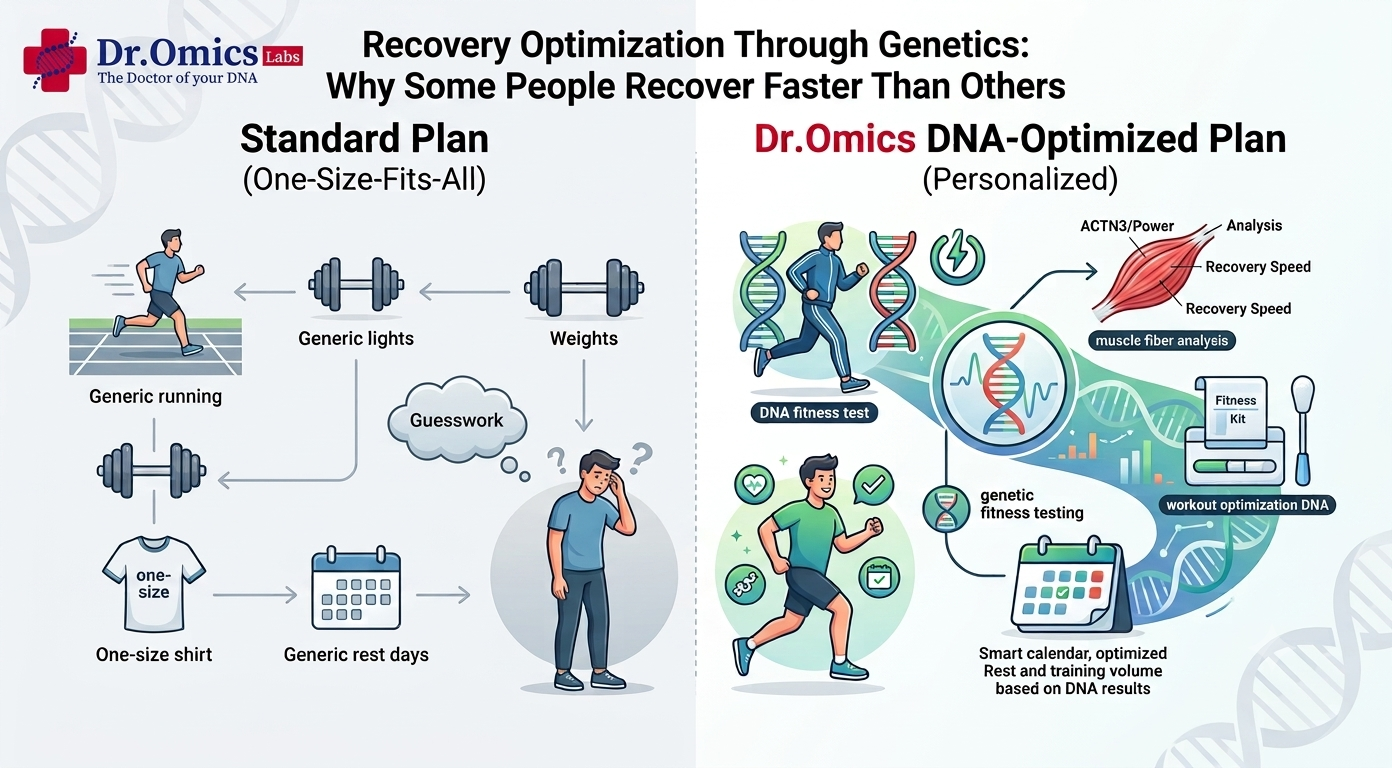
Ever wonder why your workout partner can smash a brutal leg day and bounce back completely fresh forty-eight hours later, while you’re still wincing as you sit down? It’s easy to blame your diet, sleep, or sheer mental grit. But the real answer might be written deep inside your cellular code.
Thanks to advances in genetic fitness testing, we now know that exercise recovery isn’t a one-size-fits-all formula. Your DNA plays a massive role in how your muscles rebuild, how fast your inflammation subsides, and how you should structure your rest days.
The Genetic Code of Muscle and Recovery
When you lift weights or run, you create microscopic tears in your muscle fibers. Your body’s ability to repair these tears depends heavily on exercise genetics.
A prime example is the ACTN3 sprinter gene, which controls the production of alpha-actinin-3, a protein found exclusively in fast-twitch muscle fibers. A muscle fiber type test can reveal your specific ACTN3 variant:
- The Power Profile: Individuals with two functional copies of this gene usually excel at power and speed, but the explosive strain can require distinct, targeted recovery strategies.
- The Endurance Profile: Those lacking this protein often lean toward slow-twitch endurance, handling oxidative stress differently.
Beyond raw power, fitness response genetics dictate how your body manages inflammation and oxidative stress. Genes like TNF-alpha and IL-6 regulate your inflammatory response. If your DNA profile leans toward prolonged inflammation, you are more susceptible to delayed onset muscle soreness (DOMS) and require a more deliberate approach to exercise recovery DNA planning.
Shifting to DNA-Based Training
If you are training blindly based on generic internet routines, you might be actively stalling your progress. Utilizing a DNA fitness test allows you to pivot from guesswork to high-precision, DNA-based training.
By unlocking your personalized workout DNA insights, you can structurally modify your routine based on your body’s true limits:
- Volume & Frequency: A genetic muscle analysis might show that your soft tissues (tendons and ligaments) have a higher risk of injury due to specific collagen gene variants (COL1A1). If so, your workout optimization DNA strategy will prioritize longer rest intervals between high-intensity sessions.
- Modality Splitting: Your strength training genetics and cardio fitness genetics will dictate whether you recover faster from high-intensity resistance splits or steady-state aerobic flush workouts.
Take Control with Fit Genie
You don’t have to guess what your cells need. The Fit Genie DNA test simplifies this cutting-edge science into actionable insights. By analyzing your unique markers, this fitness genetics test provides a clear roadmap of exactly how much time your body needs between workouts, which recovery modalities (like active recovery vs. complete rest) will yield the best results, and how to fuel your body to speed up tissue repair.
Stop copy-pasting someone else’s routine and expecting their results. Optimize your training, outsmart your soreness, and unlock your true athletic potential by matching your schedule to your DNA.

