
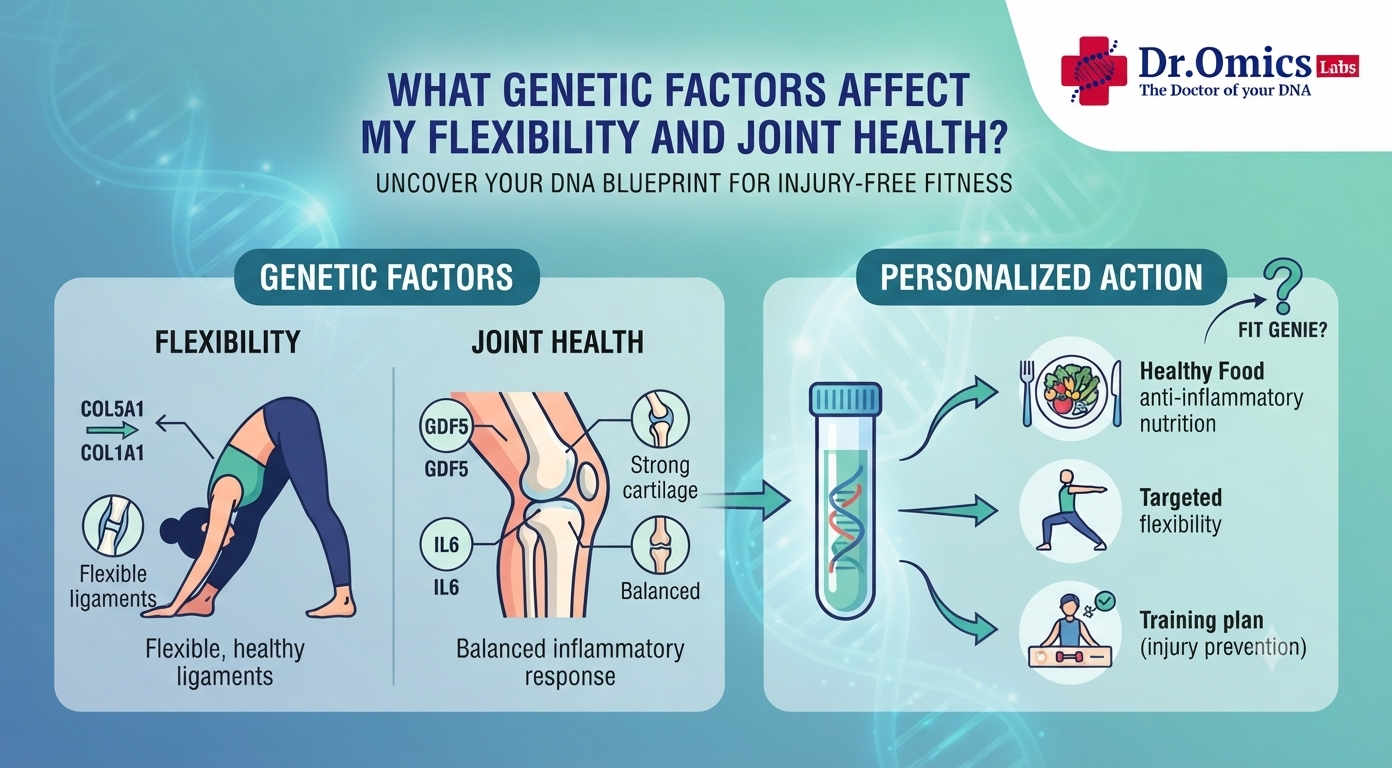
Have you ever wondered why your friend excels at yoga effortlessly while you struggle with stiffness, even with consistent practice? Or why one person can handle high-intensity training without injury, while you seem to battle chronic joint aches? The answer often lies not in your effort, but in your DNA. Understanding the genetic factors that affect your flexibility and joint health is the first step toward a smarter, more personalized approach to fitness.
The Genetic Blueprint of Your Joints
Your joints and connective tissues are governed by a specific set of genes that determine their strength, elasticity, and inflammatory response. When you ask, “what genes affect joint health?”, you are looking at the molecular scaffolding of your body.
- COL1A1 and COL11A1: These are crucial for collagen production. COL1A1 acts as the “scaffolding” for tendons, ligaments, and bones. Variants here can lead to weaker connective tissue, meaning you might need specific collagen supplementation or targeted resistance training rather than just static stretching to build stability. COL11A1 specifically maintains cartilage elasticity and hydration; variants here can make cartilage more fragile, accelerating early osteoarthritis.
- GDF5: This gene shapes joint morphology and cartilage growth. It is active throughout your life, and reduced expression can lead to joints that develop suboptimally or degrade faster.
Why Flexibility Is More Than Just Stretching
Flexibility is roughly 50% heritable. It isn’t just about how often you stretch; it is about the physical properties of your tissues.
- ACTN3: Known for its role in muscle structure, the ACTN3 gene has been linked to flexibility. Certain variants, particularly the TT genotype of the rs1815739 SNP, have been associated with reduced flexibility and a higher risk of ankle injuries.
- COL5A1: Often called the “flexibility gene,” it produces type V collagen. Mutations in this gene are common in conditions like Ehlers-Danlos Syndrome (EDS), which causes joint hypermobility. For the average person, variants in COL5A1 (like the rs12722 SNP) can lead to quadricep stiffness and an increased risk of muscle tears.
- ESR1: This gene codes for an estrogen receptor that influences collagen flexibility. Higher “C” allele counts are associated with better flexibility, while “T” alleles can decrease it.
Optimizing Fitness Through Genomics
Beyond flexibility, your DNA can explain why you hit fitness plateaus or why some build muscle faster than others. Tools like the Fit Genie test allow you to optimize fitness with DNA by identifying your unique response to training.
- Muscle Response: Genes like ACTN3 reveal your muscle fiber type—whether you are naturally built for explosive power (sprinters) or endurance. This helps determine if you should focus on HIIT vs. cardio.
- Inflammation and Recovery: Genes like IL6 and TNF regulate exercise inflammation. If you have variants that increase these markers, your body may be in a state of chronic, low-grade inflammation, making recovery slower. Knowing this allows you to adjust your rest days and incorporate anti-inflammatory nutrients.
- Oxygen Utilization: Your aerobic capacity, influenced by genes like PPARGC1A, dictates how your body uses oxygen.
How to Use This Information
Is the Fit Genie test reliable? When developed by reputable bioinformatics facilities, such tests bridge the gap between complex genetic data and actionable habits, moving you beyond “one-size-fits-all” fitness. By combining DNA insights with fitness tests, you can stop guessing and start training for your specific physiology.
For example, if your test shows a high risk for tendon injury based on COL5A1 variants, you would prioritize mobility work and eccentric loading over high-impact plyometrics. If you have variants associated with slow muscle repair, you would adjust your training volume to prevent overtraining.
Conclusion
Your genetics are not a limitation, but a roadmap. By understanding the genes that affect your joint health, flexibility, and muscle response, you can design a routine that works with your biology rather than against it. Whether you are dealing with a fitness plateau or simply want to minimize your risk of injury, personalized genomics provides the evidence-based strategy needed to achieve your goals sustainably. Remember, while your DNA provides the blueprint, your consistency and commitment to smart training remain the true drivers of your success.

