
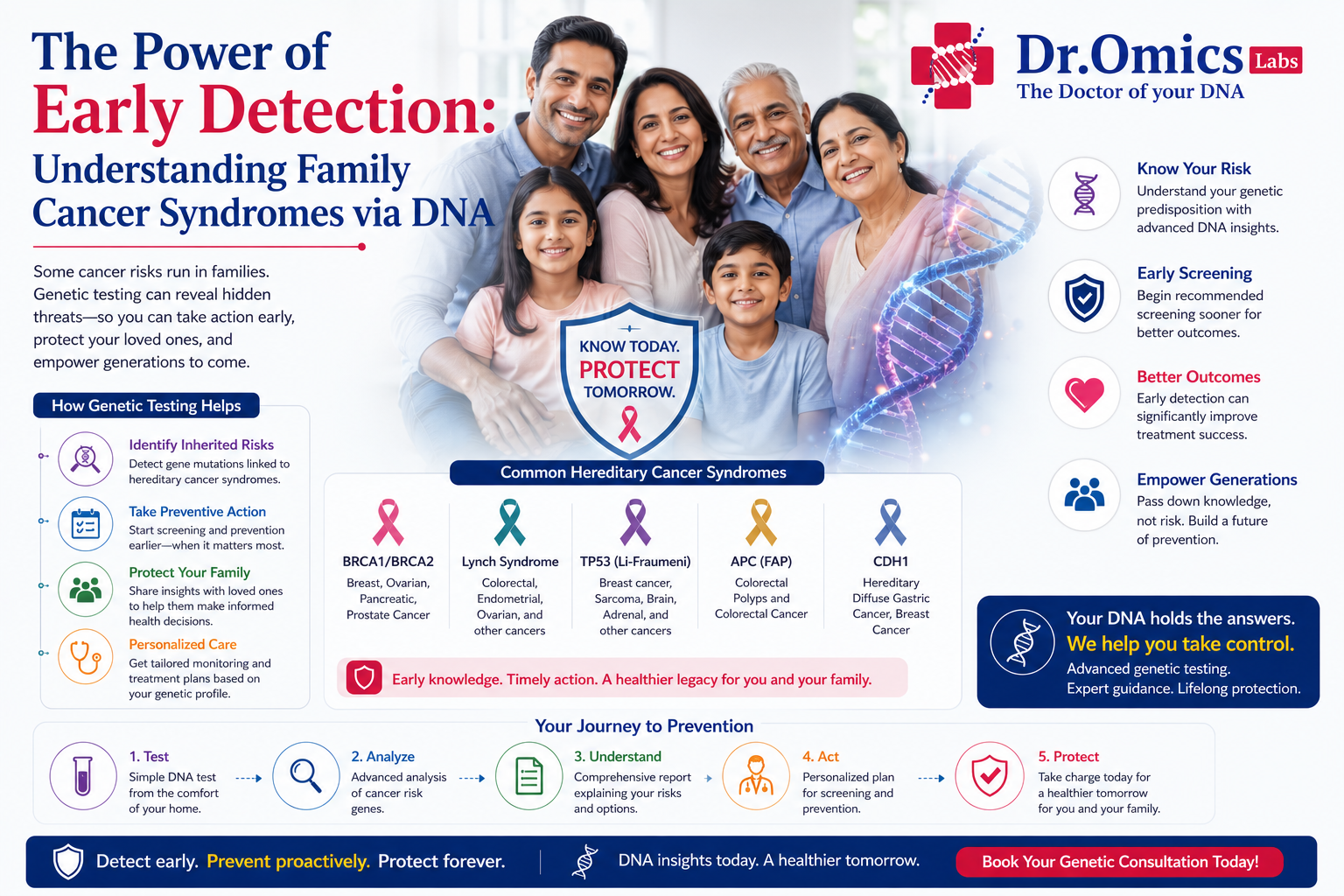
When we think about cancer, we often think of it as an unpredictable adversary—a disease that strikes without warning. However, for many families, the story of cancer is a recurring chapter across generations. In these cases, the disease isn’t just a matter of chance; it is a matter of inheritance. As we advance through the landscape of cancer genomics 2026, our ability to read these familial stories has reached an unprecedented level of precision. The Onco DNA test has emerged as a vital tool in identifying family cancer syndromes, turning a history of illness into a future of prevention.
Deciphering the Family Tree
Nearly 10% of all cancers are considered “hereditary,” meaning they are caused by a specific, harmful change in a gene that is passed from parent to child. These are known as family cancer syndromes. You might notice patterns in your own family tree: multiple relatives with the same type of cancer, individuals diagnosed at an unusually young age, or rare types of tumors appearing in several generations.
Historically, we could only watch these patterns with concern. Today, hereditary cancer screening allows us to look directly at the source. By analyzing your DNA, we can identify whether you carry a specific genetic mutation testing result that elevates your risk. This knowledge transforms “family history” from a source of anxiety into a source of actionable data.
Identifying the “Red Flags” in Your Code
An Onco DNA test typically looks for well-documented mutations in genes that are supposed to protect us. For instance:
- BRCA1 and BRCA2: While famous for their link to breast and ovarian cancer, mutations here also increase the risk of prostate and pancreatic cancers.
- Lynch Syndrome: Caused by mutations in mismatch repair genes, this syndrome significantly raises the risk for colorectal, endometrial, and gastric cancers.
- Li-Fraumeni Syndrome: A rare but high-risk condition linked to the TP53 gene, which acts as the “guardian of the genome.”
When these mutations are identified through an oncology risk assessment, the “invisibility” of the threat disappears. We no longer have to wait for a tumor to appear; we can see the vulnerability in the blueprint and act before the first cell begins to divide abnormally.
The Shift to Proactive Prevention
The true power of cancer genomics 2026 lies in what happens after the test. A positive result for a hereditary mutation is not a diagnosis of cancer; it is a powerful head start. With this information, your medical team can craft a “Precision Prevention” strategy tailored specifically to your risk level.
This might include:
- High-Intensity Surveillance: Using advanced imaging like MRIs or specialized scopes more frequently and at an earlier age than the general population.
- Risk-Reducing Measures: In some cases, preventive surgeries or specific medications can lower the chances of cancer developing by over 90%.
- Family Empowerment: Identifying a mutation in one person allows siblings, children, and parents to undergo their own hereditary cancer screening, potentially saving multiple lives within a single family.
Knowledge as a Shield
It is natural to feel hesitant about genetic mutation testing. Many fear that knowing their risk will lead to constant worry. However, the opposite is often true. The “mystery” of a family’s health history is often more stressful than the reality of a managed risk.
An oncology risk assessment provides clarity. It replaces the “if” and “when” with a concrete plan. In the fight against cancer, time is the most valuable currency. By detecting a predisposition through an Onco DNA test, you are buying yourself the most precious thing of all: the time to prevent, the time to monitor, and the time to live.
Conclusion
We are no longer powerless against the cancers that run in our families. By embracing the insights of cancer genomics 2026, we can break the cycle of hereditary disease. Understanding your family cancer syndrome via DNA is the ultimate act of proactive health. It is a choice to stand as a “Genetic Guard” for yourself and the generations that follow. Take the first step toward certainty—because when it comes to cancer, the greatest power is knowing it’s coming and being ready to stop it.

