
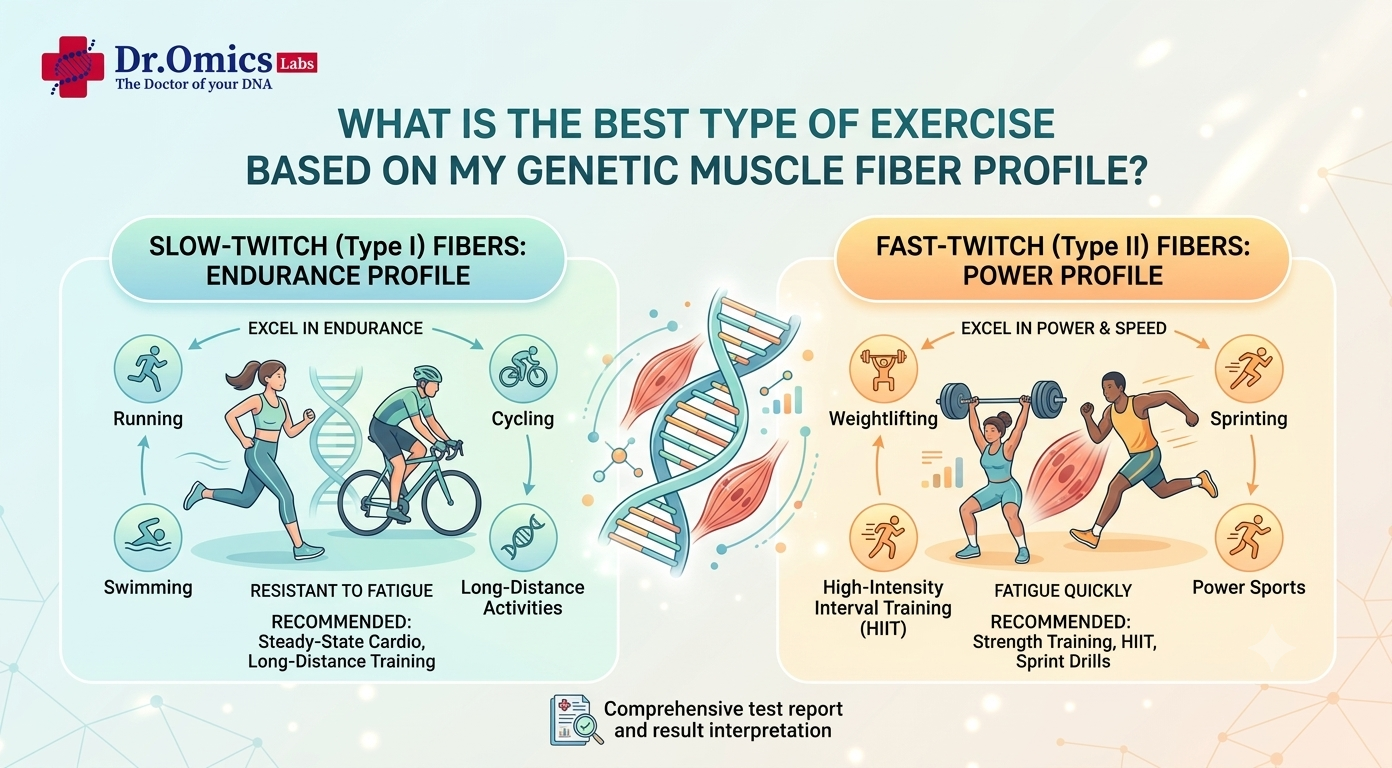
Have you ever wondered why some people thrive on sprint workouts while others excel at long-distance running? Or why does your friend gain muscle quickly despite following the same routine as you? The answer may lie in your DNA. Advances in genetic science now make it possible to understand how your body responds to exercise, helping answer questions like what is the best exercise based on DNA and can DNA personalize my workout routine.
Your genetic makeup influences muscle composition, recovery speed, endurance, flexibility, and even your risk of injury. By combining DNA insights with real-world fitness assessments, you can create a smarter and more effective training plan.
Understanding Your Genetic Muscle Fiber Profile
Every person has a unique mix of fast-twitch (Type II) and slow-twitch (Type I) muscle fibers. A muscle fiber type test analyzes genetic markers associated with these fibers to determine whether your body is naturally inclined toward explosive power, endurance, or a balance of both.
One of the most studied genes is ACTN3, often called the “sprinter gene.” If you’re wondering what ACTN3 is for sprinters, this gene influences the production of a protein found in fast-twitch muscle fibers. Certain ACTN3 variants are linked to greater sprinting and power performance, while others may favor endurance activities.
Can DNA Determine HIIT vs. Cardio?
Many people ask, does DNA determine HIIT vs cardio? While genetics doesn’t make the decision for you, it provides valuable guidance.
If your DNA indicates stronger fast-twitch muscle development, you may perform better with:
- High-Intensity Interval Training (HIIT)
- Sprinting
- Olympic lifting
- Strength training
If your genetics favor slow-twitch fibers, you may excel at:
- Distance running
- Cycling
- Swimming
- Long-duration aerobic exercise
This is one reason DNA show workout response is becoming an increasingly common question in fitness science.
Why Do Some People Build Muscle Faster?
If you’ve ever asked, why do some build muscle faster, genetics is one of the biggest factors. Multiple genes influence muscle growth, protein synthesis, hormonal response, and recovery.
Similarly, how genetics affect muscle recovery depends on genes involved in inflammation, collagen production, and tissue repair. Certain individuals naturally recover faster after intense workouts, while others require longer recovery periods to avoid injury.
Researchers also study what genes affect exercise inflammation and what genes affect joint health, helping athletes understand their susceptibility to soreness, tendon issues, and chronic joint stress.
Beyond Muscles: Oxygen Utilization and Endurance
Your DNA doesn’t only influence strength—it also impacts endurance.
Studies examining how DNA affects oxygen utilization reveal that genetic variations can influence aerobic efficiency, VO₂ max potential, and cardiovascular adaptation.
These insights help answer questions like:
- How to use DNA for endurance training
- Can DNA predict overtraining risk
- Does genetics determine strength potential
When training aligns with your biology, you can often improve performance while reducing unnecessary fatigue.
How to Combine DNA with Fitness Tests
Genetic information is most powerful when paired with physical assessments. If you’re wondering how to combine DNA with fitness tests, the answer is simple: use DNA as the blueprint and fitness testing as the progress tracker.
A comprehensive solution like Fit Genie integrates genetic insights with evidence-based fitness recommendations. It can help identify why certain training methods work better for you, explain recovery differences, and even answer questions like can Fit Genie explain fitness plateau by highlighting biological factors that traditional training plans overlook.
Many users also ask, are genetic fitness tests accurate and is Fit Genie test reliable? While DNA cannot predict every aspect of athletic performance, modern genetic testing is supported by scientific research and provides valuable information when combined with proper coaching, nutrition, and consistent training.
Train Smarter with Your DNA
There is no universal “perfect workout.” The ideal fitness plan is the one that matches your unique biology. Understanding how to optimize fitness with DNA allows you to choose exercises aligned with your muscle fiber profile, recovery capacity, endurance potential, and injury risk.
Instead of relying on trial and error, genetic testing offers a personalized roadmap that helps you train more efficiently, recover better, and unlock your full athletic potential. With tools like Fit Genie, your DNA becomes more than just genetic information—it becomes your personalized guide to lifelong fitness success.

