
In the pursuit of peak athletic performance, many athletes rely on rigorous training, precise nutrition, and advanced recovery techniques. Yet, one of the most unpredictable elements remains the “injury bug.” Athletes often wonder: can DNA testing identify my risk for ACL tears or muscle strains? As sports science evolves, genetic testing is increasingly positioned as a tool to uncover the biological blueprint behind injury susceptibility.
The Genetic Foundation of Injury
While training and technique are paramount, your DNA plays a significant role in your physical resilience. Research suggests that musculoskeletal injury risk—including tendon, ligament, and muscle damage—has a notable polygenic component.
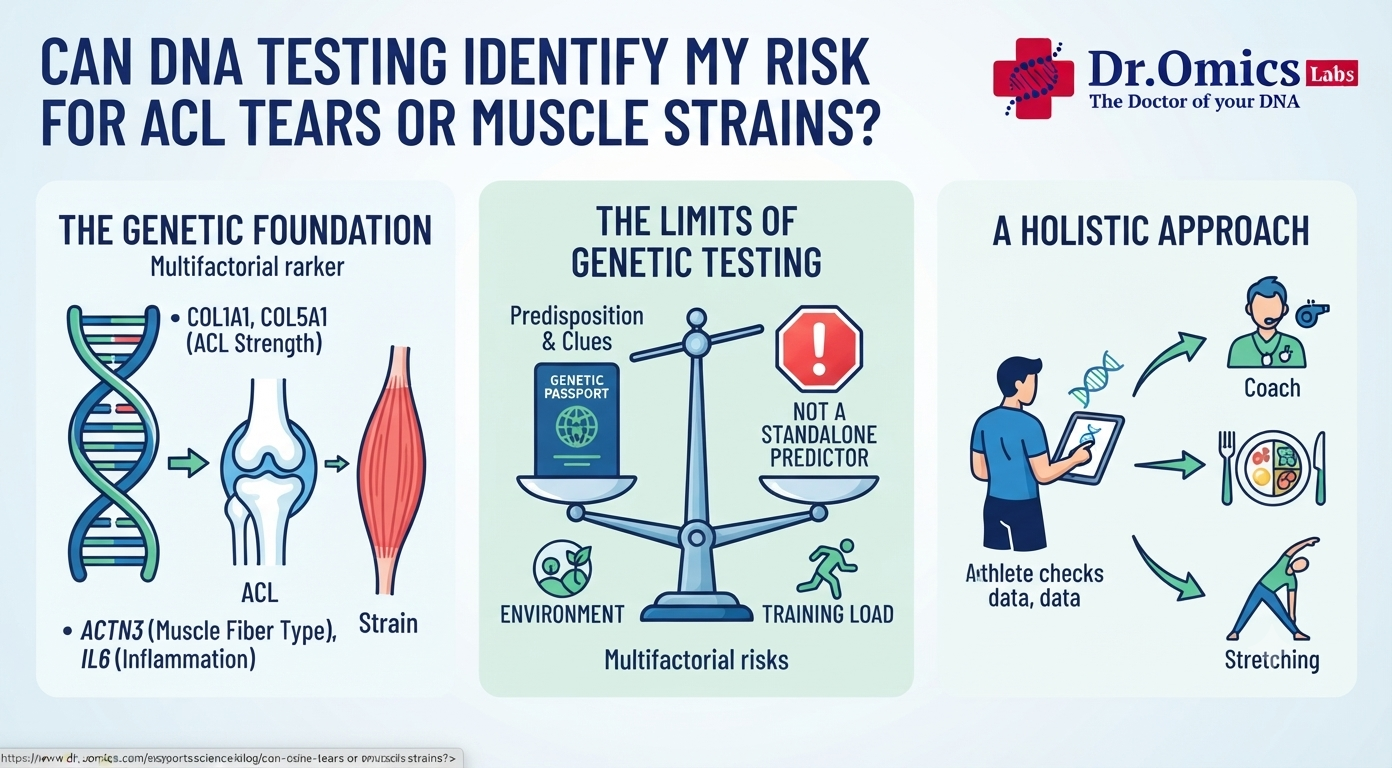
For example, the ACL (Anterior Cruciate Ligament) injury risk has a high heritability, estimated at approximately 69%. Specific genetic variants in collagen-related genes, such as COL1A1, COL5A1, and COL12A1, are often investigated for their role in the structural integrity of ligaments. Variations in these genes can influence collagen production, potentially leading to structurally weaker tendons or ligaments that are more prone to micro-tears under stress.
Similarly, muscle strains are influenced by genetic factors, though the evidence here is still emerging compared to ligament research. Genes like ACTN3—often called the “speed gene”—influence muscle fiber composition and may correlate with injury risk in high-intensity activities. Other genes, such as IL6 and SOD2, regulate inflammatory responses and antioxidant capacity, which are critical for how quickly and effectively your body recovers from training-induced damage.
Can DNA Testing Optimize Your Training?
Athletes often ask how to optimize training with DNA and does genetics determine ideal workout plans. Proponents of sports DNA testing argue that these insights allow athletes to “work smarter” by:
- Early Risk Identification: Highlighting genetic predispositions to weakened collagen or poor recovery.
- Customized Injury Prevention: Using genetic data to implement proactive measures, such as targeted strengthening or adjusted training loads, before an injury manifests.
- Enhanced Recovery: Understanding genetic markers for inflammation (e.g., IL6) to tailor post-workout recovery protocols.
While these tests offer personalized insights, it is important to understand that is sports DNA testing accurate? Scientific consensus is cautious. While associations exist, many genetic markers have not been independently replicated across diverse populations, and clinical sensitivity and specificity are often considered inadequate for predicting individual injury outcomes.
The Limits of Genetic Testing
It is vital to recognize that how much of performance is genetic is only part of the story. Genetics are not destiny. Musculoskeletal injuries are multifactorial, arising from the complex interplay of intrinsic (genetic) and extrinsic (environment, training load, nutrition) factors.
For athletes seeking to improve performance or mitigate risk, relying solely on a DNA test may be premature. Personalized injury prevention is already achievable today through individualized assessment and management of modifiable risk factors—such as monitoring training volume, maintaining proper form, and ensuring adequate nutrition—even in the absence of fully validated genetic markers.
Conclusion
Can DNA testing identify your risk for ACL tears or muscle strains? It can provide a “genetic passport” that offers clues about your predisposition to ligament strength, inflammation response, and recovery capacity. However, current scientific evidence does not support using these tests as reliable, standalone predictors for specific injury events.
If you choose to pursue sports DNA testing, view it as one piece of a much larger puzzle. The most effective injury prevention strategy remains a holistic approach: combine your genetic insights with evidence-based training, professional coaching, and careful attention to your body’s signals. By treating your DNA as a guide rather than a rulebook, you can make informed decisions that support your long-term athletic health and performance.

